Cookie Settings
We use cookies to provide an optimal experience for you. Technically required cookies are used for making shopping possible, statistics are used for anonymized Google Analytics. You can read everything in our updated privacy policy.
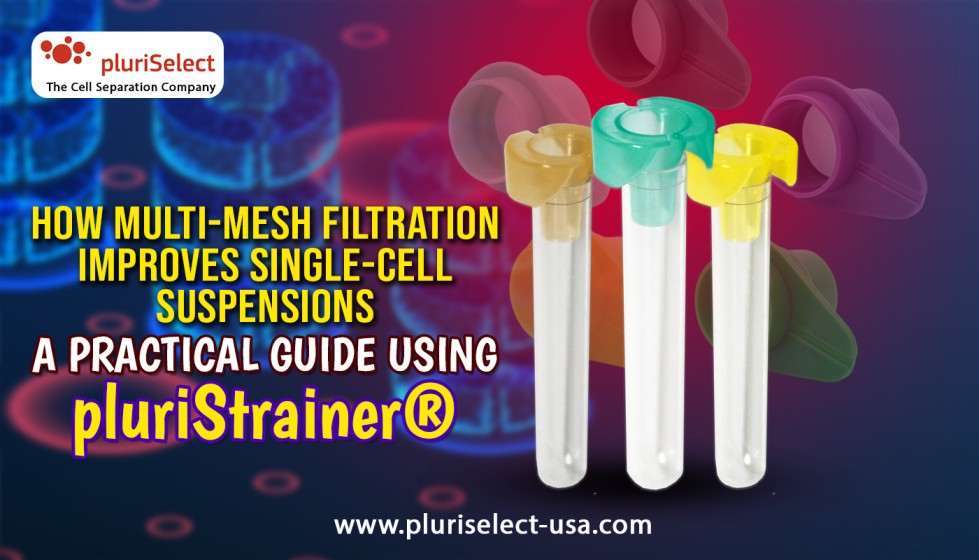
Preparing high-quality single-cell suspensions is one of the most important steps in many laboratory workflows. Whether the goal is cell isolation, culture, flow cytometry, or downstream molecular assays, the quality of the cell suspension determines how reliable the results will be. Yet many researchers still struggle with clumping, debris, and inconsistent yields—issues that often begin at the filtration step.
This is where multi-mesh filtration becomes a practical solution. By passing samples through a series of mesh sizes in a controlled and simple way, labs can quickly move from raw tissue or viscous material to a clean, high-quality single-cell suspension. And one tool that has helped many researchers achieve this with ease is the pluriStrainer®, a versatile and user-friendly sieving device designed to support routine cell preparation.
In this guide, we explore how multi-mesh filtration works, why it improves single-cell suspensions, and how the pluriStrainer® makes this process faster, cleaner, and more predictable for labs of all sizes.
Almost every cell preparation workflow begins with filtration. Any tissue digestion, enriched sample, or primary material will contain clusters, debris, extracellular matrix remnants, and other unwanted components that lower the quality of the final cell suspension.
When filtration is insufficient, several issues occur:
Clogs in downstream instruments, especially flow cytometers and microfluidic devices
Inaccurate cell counts due to clumps
Lower purity because undissociated fragments trap unwanted cells
Reduced viability, particularly when physical stress increases during sample handling
Inconsistent experimental outcomes
Multi-mesh filtration offers a structured way to solve these issues. By filtering through more than one mesh size, researchers can separate fractions more clearly and obtain suspensions that behave like true single-cell samples.
Multi-mesh filtration simply means passing a sample through two or more mesh sizes sequentially. Each mesh removes particles above a certain size. When these meshes are stacked or used one after another, the sample is cleaned in layers—removing unwanted material while keeping the target cells intact.
This stepwise approach benefits:
Primary tissue digests
Organoid preparations
Blood and bone marrow samples
Spleen, thymus, lymph node, or pancreas cell suspensions
Mammary gland tissue and more
The goal is simple: move from a complex sample to a uniform population of single cells, ready for sensitive assays.
The pluriStrainer® is designed specifically for filtration and purification of liquids in laboratory workflows. It fits major 50 mL conical tubes and is available in multiple mesh sizes:
70 µm, 100 µm, 200 µm, 300 µm, 400 µm, and 500 µm
This range makes it ideal for multi-mesh filtration, where researchers can customize their filtration stack based on sample type.
Traditional strainers trap air underneath the mesh, slowing filtration and causing uneven flow. The pluriStrainer® has built-in ventilation channels that allow unobstructed air escape, reducing clogging and accelerating the flow.
pluriStrainer® units can be stacked directly on top of each other. This allows researchers to:
Filter multiple size classes at the same time
Create customized workflows for different tissues
Avoid transferring material between tubes
Stacking also reduces contamination risks and speeds up processing time.
Sometimes the larger fraction is the one researchers need. With pluriStrainer®, simply reverse the strainer onto a fresh tube and wash the retained material into it. This makes it ideal for:
Organoid isolation
Filtering debris while keeping larger clusters
Recovering bead-bound cells after pluriBead® enrichment
For bigger samples, the funnel attachment allows up to 24 mL of material to be loaded directly onto the mesh. This helps when working with:
Tissue digests
Viscous liquids
Large-scale enrichment or processing workflows
The Connector Ring enables labs to:
Control flow using a Luer-Lock
Block the liquid above the mesh for brief incubations
Use low-pressure support by pulling the piston of a syringe
Dissociate tough samples gently on the mesh
This is especially useful for:
Brain and spleen dissociation
Using reagents such as TRIzol® or Buffer RLT directly on the mesh
Quick incubation, such as cytokine treatments or buffer exposure
Together, these features make pluriStrainer® a reliable tool for building multi-mesh filtration workflows tailored to research needs.
When samples are passed through a single mesh, larger debris may still pass if they deform or slip through irregular spaces. But multi-mesh filtration eliminates this problem by applying size thresholds in order.
For example:
500 µm removes large tissue clumps
300 µm clears smaller fragments
100 µm or 70 µm isolates true single cells
Researchers get a cleaner suspension with minimal debris.
Clumps form when extracellular matrix or undigested fragments trap small cell clusters. By using several mesh sizes in sequence, these structures are separated efficiently, reducing cell aggregation.
Gentle filtration prevents physical stress. Using low pressure with the pluriStrainer® Connector Ring further reduces shear forces, which is especially important for:
Primary immune cells
Stem cells
Dissociated neurons
Pancreatic islet-derived cells
Flow cytometers are sensitive to clogs, and even mild clumping changes signal patterns.
A clean single-cell suspension directly improves:
Data quality
Fluorescence intensity precision
Gating accuracy
Sorting efficiency
Multi-mesh filtration ensures the suspension behaves uniformly.
Some workflows require not only clean single cells but also the ability to capture certain sizes of material. With the reversible pluriStrainer® design, labs can collect:
Organoids
Spheroids
Bead-bound cell complexes
Large immune cell aggregates
Tissue microfragments
The tool supports both directions of filtration.
Below is a clear example of how labs can use pluriStrainer® to move from raw tissue to a high-quality single-cell suspension. This process works for mammary tissue, spleen, thymus, lymph node, pancreas, or similar samples.
Digest tissue using your preferred protocol (enzymes, incubation, gentle mechanical disruption).
Attach a 500 µm or 300 µm pluriStrainer® to a 50 mL tube.
Load the digested sample onto the mesh.
This removes:
Undigested chunks
Fibrous connective tissue
Large debris
If the large fraction is needed (e.g., organoids), reverse the strainer and recover them.
Stack a 200 µm strainer on top of a fresh tube. Filter the material to remove medium-sized clusters. This step improves clarity significantly.
Place a 70 µm or 100 µm pluriStrainer® on a new tube. Filter the remaining material to achieve a clean single-cell suspension.
Attach a syringe via the Connector Ring and gently pull the piston. This helps for:
Tougher samples
Viscous solutions
Dense cell mixtures
The resulting suspension is ready for:
Flow cytometry (FACS™)
Cell culture
pluriBead® cell enrichment
RNA extraction
Organoid seeding
Downstream assays
Tissues such as mammary gland, spleen, lymph node, pancreas, and thymus yield better suspensions when filtered through multiple mesh sizes. The improved ventilation of the pluriStrainer® prevents clogging, which helps deal with messy digests.
The pluriStrainer® is part of the pluriBead® workflow. After bead-bound target cells are captured, the strainer physically separates them from unbound cells. A clean single-cell suspension improves the accuracy of the enrichment step and speeds up washing.
Flow cytometry requires smooth suspensions free from debris. The stackable multi-mesh process ensures that only cells within the desired size range reach the sorter or cytometer.
Using the Connector Ring to block flow allows:
Short reagent incubations
On-mesh dissociation
Cytokine treatments
Buffer exposure
This reduces handling steps while improving yield.
With the help of vacuum or low pressure, even challenging liquids such as thick digests, high-EV fractions, or viscous organoid preparations can be processed.
Researchers can briefly expose cells to reagents such as:
TRIzol®
Buffer RLT
Cell lysis reagents
Dissociation enzymes
The mesh retains the sample for a short time, and then flow is reopened for the filtration step.
Labs that process multiple samples every day need tools that perform consistently.
pluriStrainer® reduces troubleshooting, sample loss, and downtime.
High-quality single-cell suspensions lead to clearer results and fewer repeat experiments.
This saves time, reagents, and labor costs.
Whether processing a single biopsy or routine batches, multi-mesh setups are easy to standardize across teams.
pluriStrainer® fits all major 50 mL conical tubes, funnels, and standard workflows without requiring specialized devices.
The funnel option expands capacity to support larger workloads—a benefit for clinical research labs or high-throughput environments.
Always start with the largest mesh to prevent smaller meshes from clogging during filtration.
Use the funnel for large volumes to keep the filtration flow smooth and consistent.
Stack multiple meshes when separating various cell sizes or maintaining an organized workflow.
Reverse the strainer to easily recover large fragments like organoids or bead-bound complexes.
Use the Connector Ring with a syringe to gently apply low pressure for tough samples.
Control flow speed by adjusting the Luer-Lock opening according to your sample’s needs.
Handle delicate cells gently by avoiding force; allow gravity flow to protect cell integrity.
Many laboratories rely on basic cell strainer, but the pluriStrainer® offers features that genuinely elevate everyday workflows. Its range of mesh sizes makes it easy to design true multi-mesh filtration steps, giving users more control when preparing single-cell suspensions. You can begin with a larger mesh to remove bulky debris and gradually transition to finer meshes—all within one streamlined setup.
Improved ventilation is another key advantage. Better airflow means fewer clogs, smoother filtration, and less time spent troubleshooting flow interruptions. The ability to stack pluriStrainer® units adds convenience, allowing multiple mesh sizes to be used in sequence without transferring material between tubes. This reduces handling steps and helps minimize the risk of contamination.
The reversible design is equally practical. Turning the device upside down and flushing it allows users to quickly recover organoids, tissue fragments, bead-bound complexes, or other materials that should not pass through the mesh. For high-volume samples, the funnel compatibility ensures that large loads can be processed efficiently without spillover.
The Connector Ring adds control by regulating flow speed and enabling gentle low pressure when needed. And because the pluriStrainer® fits standard 50 mL centrifuge tubes, it integrates seamlessly into most lab setups. Together, these features make it a flexible and dependable tool for modern single-cell preparation.
Multi-mesh filtration remains one of the most straightforward and reliable ways to improve the quality of single-cell suspensions. By passing samples through a series of mesh sizes, researchers can efficiently remove debris, limit cell clumping, and create cleaner preparations that perform better in downstream applications such as flow cytometry, culture, analysis, or enrichment. This step not only improves data consistency but also helps protect instruments and reduces the need for repeated processing.
The pluriStrainer® brings practicality to this workflow with its smart, user-friendly design. Its stackable format allows filtration through multiple meshes without repeated transfers, while the reversible feature helps recover valuable material that would normally be lost. Improved ventilation minimizes clogging, keeping the process smooth even with challenging samples. With options for flow regulation and gentle low pressure using the Connector Ring, researchers gain more control over how their samples move through the mesh. Its compatibility with standard 50 mL tubes also makes it easy to plug into existing lab routines.
For laboratories aiming to simplify sample preparation, increase reproducibility, and reduce hands-on handling, the pluriStrainer® offers a dependable and efficient way to adopt multi-mesh filtration. It provides a practical, consistent solution that supports cleaner, more reliable single-cell suspensions every day.



 The Cell Separation Company