Cookie Settings
We use cookies to provide an optimal experience for you. Technically required cookies are used for making shopping possible, statistics are used for anonymized Google Analytics. You can read everything in our updated privacy policy.
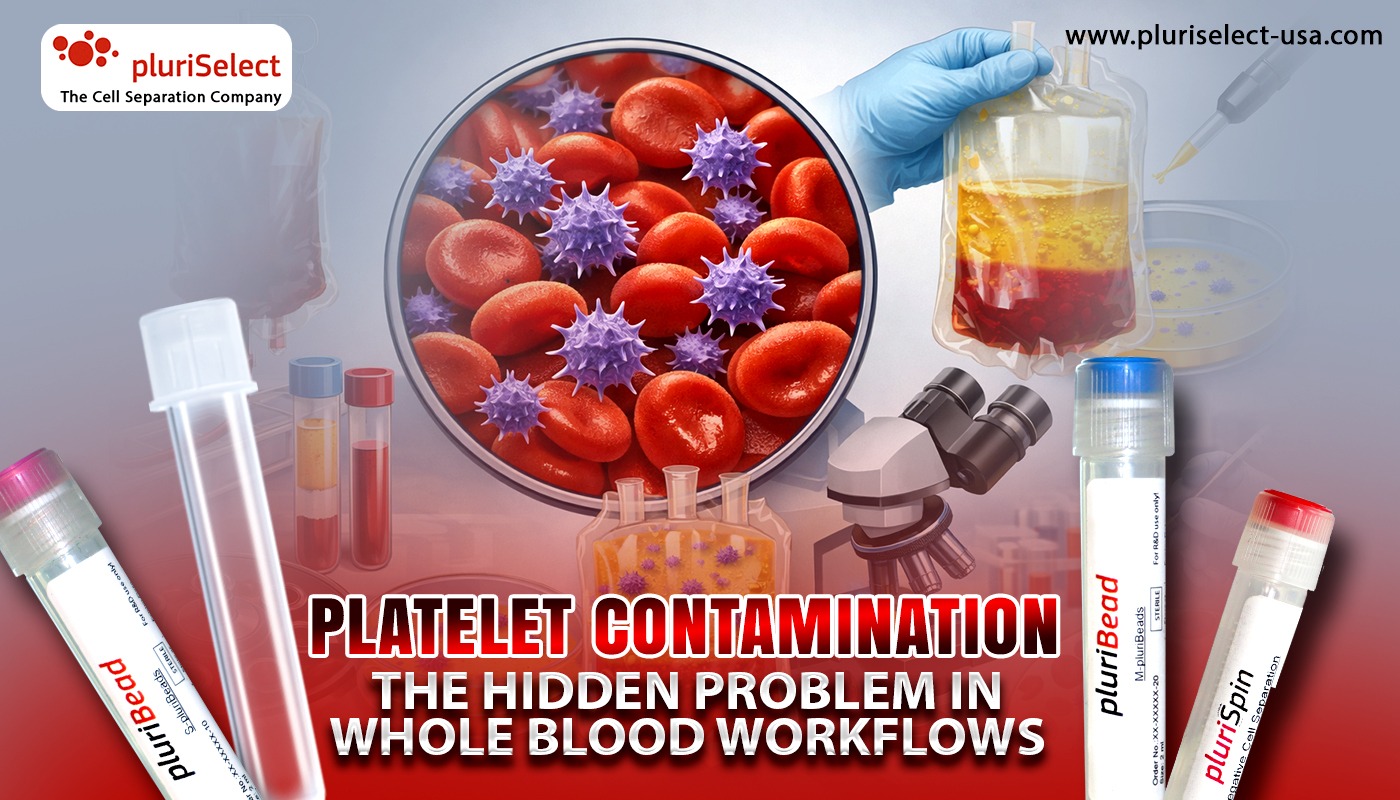
Whole blood workflows are widely used in research and clinical laboratories for isolating immune cells, preparing samples for analysis, and supporting downstream applications such as flow cytometry and cell culture. While these workflows are well established, they often include a hidden issue that can affect results in subtle but significant ways, platelet contamination.
Unlike larger cells, platelets are small, sticky, and highly reactive. Because of their size and behavior, they are often overlooked during sample preparation. However, their presence can influence cell purity, interfere with assays, and introduce variability into experiments.
In many cases, the effects of platelet contamination are not immediately visible. Instead, they appear later in the workflow, making it difficult to identify the root cause of inconsistent results. As cell separation technology continues to advance, the need for cleaner and more reliable sample preparation has become more important. Addressing platelet contamination is a key part of improving both efficiency and accuracy in modern workflows.
This article explores how platelet contamination occurs, why it matters, and how targeted solutions like pluriSpin® and pluriSpin® Human PLT Depletion help resolve this issue effectively.
Platelets are small, cell-like fragments in blood that play a central role in clotting and wound healing. They are produced from larger precursor cells in the bone marrow and circulate in the bloodstream to help stop bleeding when vessels are damaged. Unlike white blood cells, platelets do not contain a nucleus, but they are still highly active and responsive to their surroundings.
Key characteristics of platelets include:
Small size compared to other blood components
Platelets are much smaller than most cells found in blood, which allows them to remain suspended in plasma and pass through many separation steps without being easily removed.
High reactivity to physical and chemical changes
Platelets can become activated by factors such as temperature shifts, mechanical stress, or contact with surfaces. Once activated, they change shape and become more adhesive.
Ability to bind to other cells and surfaces
Activated platelets can attach to leukocytes, endothelial cells, and even laboratory materials. This makes them difficult to separate from target cell populations.
Because of these properties, platelets behave differently during sample preparation. They can remain freely suspended in plasma, making them hard to remove with standard centrifugation. At the same time, they may adhere to target cells or form small aggregates, especially if the sample has been handled extensively or stored for longer periods.
This dual behavior, remaining both free-floating and adhesive, makes platelets particularly challenging in laboratory workflows. While their biological role is essential in the body, their presence during sample preparation can lead to complications. These include reduced purity of isolated cells, increased clumping, and interference with downstream applications. For workflows focused on isolating specific cell populations, understanding platelet behavior is an important step toward improving overall sample quality.
Platelet contamination can occur at multiple stages of sample handling.
Even at the earliest stage, platelets can become activated due to:
Mechanical stress
Temperature changes
Delays in processing
Activated platelets are more likely to stick to other cells or surfaces.
As blood samples age, platelet behavior changes.
Older samples show increased platelet aggregation
Platelets may release signaling molecules
Interaction with other cells becomes more pronounced
This makes platelet contamination more severe in samples processed several hours after collection.
Centrifugation is a critical step in many workflows, but it does not always remove platelets effectively.
Platelets often remain in the plasma layer
Some migrate into the interphase
Others bind to target cells
As a result, they are frequently carried into the final sample.
Repeated pipetting, mixing, or transfers can:
Activate platelets
Increase binding to other cells
Promote clump formation
These effects accumulate throughout the workflow.
One of the biggest challenges with platelet contamination is that it is not always obvious.
Unlike large debris or visible aggregates, platelets:
Are difficult to detect visually
May not affect early workflow steps
Often go unnoticed until later analysis
This makes them a “hidden” problem that can quietly affect results.
Researchers may notice:
Unexpected variability
Reduced purity
Inconsistent assay outcomes
Without realizing that platelets are contributing to these issues.
Platelet contamination can affect multiple stages of a workflow, often in ways that are not immediately obvious. While platelets are small, their behavior can influence both the physical and functional properties of a sample.
Reduced Purity of Target Cells
Platelets can attach to target cells such as lymphocytes or monocytes, forming complexes that are difficult to separate. This results in:
Mixed cell populations, where unwanted material remains in the sample
Lower isolation purity, reducing the quality of the final cell fraction
Reduced effectiveness of cell enrichment techniques, as bound platelets interfere with accurate separation
Over time, this can make it harder to obtain clean and reliable cell populations for downstream use.
Cell Clumping and Aggregation
Platelets are naturally adhesive, especially when activated during handling. They can:
Promote clump formation by acting as bridges between cells
Bind multiple cells together, creating clusters
Form aggregates that are difficult to break apart
These aggregates can disrupt workflows by making samples harder to process and analyze.
Interference with Flow Cytometry (FACS)
Platelets can significantly affect flow cytometry results. They may:
Alter signal detection by binding to target cells or contributing their own signals
Increase background noise, making it harder to distinguish cell populations
Cause variation in measured parameters, especially in size and fluorescence
These effects reduce data accuracy and make results less reproducible across experiments.
Impact on Cell Culture
In culture conditions, platelets can actively influence the environment. They can:
Release growth factors and signaling molecules that affect cell behavior
Occupy space, limiting available surface area or nutrients
Interact with cultured cells, altering growth patterns or responses
This leads to less controlled conditions, making it difficult to interpret experimental outcomes.
Effects on Molecular and Functional Assays
Platelets can introduce variability in assays that depend on precise cellular behavior. This includes:
Cytotoxicity assays, where platelet interactions may alter target cell responses
Immune response studies, where signaling molecules from platelets affect results
Molecular analysis, where contamination can influence RNA, DNA, or protein measurements
Even small amounts of platelet contamination can impact sensitive assays, leading to inconsistent or misleading data.
Together, these issues show that platelet contamination is not just a minor inconvenience, it is a factor that can influence the entire workflow, from sample preparation to final analysis.
Many standard workflows attempt to reduce platelet presence, but these methods often fall short, especially when high purity and consistency are required. The main challenge is that platelets do not behave like typical cells during separation. Their small size, low density, and tendency to bind to other cells make them difficult to remove using conventional techniques.
Standard Centrifugation
Density-based separation is widely used in whole blood workflows, but it is not optimized for complete platelet removal. During centrifugation:
Platelets remain in the plasma layer, where they are not fully separated from other components
Some platelets migrate into the interphase, where target cells such as PBMCs are collected
Complete removal is difficult, as platelets can overlap with the density range of desired cells
As a result, even well-executed centrifugation steps often leave residual platelet contamination in the final sample.
Washing Steps
Repeated washing is commonly used to reduce platelet levels, but it comes with trade-offs:
Increases handling time, making workflows longer and more labor-intensive
May activate platelets, especially with repeated centrifugation or pipetting
Can lead to cell loss, as target cells may be discarded along with platelets
While washing can reduce platelet numbers, it rarely eliminates them completely and may negatively affect sample quality.
Mechanical Removal
Some workflows rely on physical methods to reduce platelet presence, such as filtration or manual separation. However, these approaches can introduce additional challenges:
Potential damage to cells due to mechanical stress
Increased variability, as results depend on operator technique
Inconsistent outcomes between samples, especially with complex or aged blood
These methods often lack precision and control, making them unreliable for consistent platelet removal.
Together, these limitations show that traditional approaches are not designed to address the specific challenges posed by platelets. Their unique behavior requires a more targeted and controlled strategy, one that removes platelets effectively while preserving the integrity of the target cells.
pluriSpin® is designed as a negative isolation system that removes unwanted cells, including platelets, while leaving target cells untouched.
The sample is incubated with pluriSpin® reagent
The reagent binds unwanted cells
During density gradient centrifugation:
Labeled unwanted cells pellet
Target cells remain at the interphase
This process allows for:
Clean separation
Minimal handling
Immediate use of isolated cells
pluriSpin® Human PLT Depletion specifically targets platelets.
Selective Platelet Removal
Platelets are removed without affecting target cells.
Improved Purity
Cleaner samples with reduced contamination.
Better Performance with Older Samples
Effective even when platelet levels are higher.
Reduced Cell Clumping
Minimizes aggregation caused by platelets.
Removing platelets improves the efficiency of cell enrichment techniques.
Benefits include:
Better separation performance
Higher yield of target cells
Reduced variability
This is especially important in workflows involving rare cell populations.
Cleaner samples lead to:
Better signal clarity
Reduced noise
More consistent data
Without platelets:
Cells grow more predictably
External influences are reduced
Accurate results in:
Cytotoxicity testing
Immune response studies
Cleaner inputs lead to more reproducible outcomes.
Even with advanced tools, proper handling plays a key role in reducing platelet contamination. Since platelets are highly sensitive and easily activated, small improvements in technique can make a noticeable difference in sample quality.
Gentle Sample Handling
Platelets respond quickly to mechanical stress. Rough handling can activate them, making them more likely to stick to other cells or form aggregates. To prevent this, samples should be handled with care, avoid vigorous shaking, rapid pipetting, or repeated transfers. Using slow and controlled movements helps keep platelets in a less reactive state and reduces unwanted interactions.
Timely Processing
The longer a sample sits after collection, the more likely platelets are to change behavior. Over time, they can become more adhesive, release signaling molecules, and form clumps. Processing samples as soon as possible helps maintain their original condition and reduces complications during separation.
Proper Centrifugation Settings
Centrifugation plays a central role in separating blood components, but incorrect settings can disturb the process. Using appropriate speed and timing ensures better layer formation. It is also important to avoid harsh braking, as this can disrupt layers and allow platelets to mix into the interphase. Stable and controlled centrifugation improves separation quality.
Use of Targeted Depletion Methods
Handling techniques alone are not always enough to fully remove platelets. For more reliable results, it is important to use targeted depletion approaches. Solutions like pluriSpin® and pluriSpin® Human PLT Depletion are designed to remove platelets while preserving target cells. These methods provide a more controlled and consistent way to improve sample purity.
By combining careful handling with targeted solutions, laboratories can significantly reduce platelet contamination and achieve more consistent results across workflows.
Platelet contamination is a common but often overlooked issue in whole blood workflows. While small and difficult to detect, platelets can have a significant impact on sample quality, experimental accuracy, and reproducibility.
From interfering with cell separation technology to reducing the effectiveness of cell enrichment techniques, their presence can affect multiple stages of the workflow. Traditional methods are often not sufficient to remove platelets completely, especially without introducing additional variability or cell loss. pluriSpin® and pluriSpin® Human PLT Depletion provide a practical and efficient solution. By using a negative isolation approach, they remove platelets while preserving the integrity and functionality of target cells.
For laboratories aiming to improve sample quality and achieve more consistent results, addressing platelet contamination is not optional, it is essential. And with the right tools, it becomes a manageable and reliable part of the workflow.











 The Cell Separation Company