Antibody supported

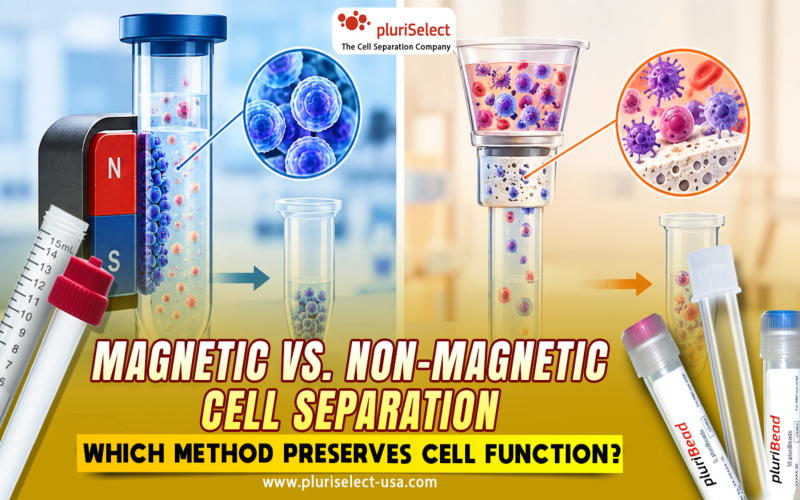
Magnetic vs. Non-Magnetic Cell Separation: Which Method Preserves Cell Function?

Magnetic vs. Non-Magnetic Cell Separation: Which Method Preserves Cell Function?
Cell separation is often treated as a preparation step, but what happens during isolation can...
Read more

How pluriSpin® Isolates Untouched Cells Without Magnets or Columns

How pluriSpin® Isolates Untouched Cells Without Magnets or Columns
Isolating a specific cell population from a mixed sample often requires more than simply separating...
Read more

How Antibody-Based Cell Isolation Improves Rare Cell Recovery

How Antibody-Based Cell Isolation Improves Rare Cell Recovery
Rare cell populations play a critical role in many areas of life science research. Whether...
Read more

Five Common Cell Separation Challenges and How to Solve Them

Five Common Cell Separation Challenges and How to Solve Them
Cell separation is a fundamental step in many areas of life science research, including immunology,...
Read more

How pluriSpin® Human CD19⁺ Cell Depletion Helps Researchers Isolate Cleaner Non-B Cell Populations

How pluriSpin® Human CD19⁺ Cell Depletion Helps Researchers Isolate Cleaner Non-B Cell Populations
The ability to isolate specific immune cell populations is critical for many areas of biomedical...
Read more

How Advanced Cell Separation Improves Stem/Progenitor Cell Studies

How Advanced Cell Separation Improves Stem/Progenitor Cell Studies
Stem and progenitor cell research continues to expand across vascular biology, immunology,...
Read more

Platelet Contamination: The Hidden Problem in Whole Blood Workflows

Platelet Contamination: The Hidden Problem in Whole Blood Workflows
Whole blood workflows are widely used in research and clinical laboratories for isolating immune...
Read more

Choosing Between Positive and Negative Separation: A Practical Guide for Routine Lab Work

Choosing Between Positive and Negative Separation: A Practical Guide for Routine Lab Work
Two of the most commonly used methods are positive cell separation and negative cell separation.
Read more