Cookie Settings
We use cookies to provide an optimal experience for you. Technically required cookies are used for making shopping possible, statistics are used for anonymized Google Analytics. You can read everything in our updated privacy policy.

Isolating a specific cell population from a mixed sample often requires more than simply separating cells from their surrounding material. Researchers may need a population that is enriched but has not been directly labeled or captured during the separation process. This is particularly relevant when the isolated cells will be used for further biological studies.
Many cell separation workflows directly target the cells of interest. While this can be effective for obtaining a specific population, it also means that the target cells interact with the antibodies or particles used during selection.
pluriSpin® takes a different approach. It uses negative selection, meaning that the cells researchers want to keep are not the cells being targeted. Instead, unwanted cell populations are identified and separated from the sample. The process also does not rely on magnets or columns. Density gradient centrifugation is used to complete the separation, providing a straightforward alternative to magnetic or column-based workflows.
The result is an approach designed around a simple objective: remove unwanted cells while leaving the desired population unbound and available for downstream applications.
The term “untouched cells” refers to a target cell population that has not been directly labeled with the selection components used to perform the separation.
This distinction is important because there are different ways to obtain an enriched cell population. In positive selection, the cells of interest are directly targeted. Selection antibodies or particles bind to those cells so they can be captured and separated from the rest of the sample. Untouched cell isolation reverses this strategy.
Instead of placing a label on the target population, the separation process focuses on the cells that are not wanted. Once these unwanted populations are identified and removed, the desired cells remain available without having been directly targeted during selection. This approach can be useful when researchers want to study the target cells without introducing a direct selection interaction.
The reason for choosing untouched cells depends on the downstream experiment. Researchers may want to investigate cell behavior, perform functional studies, culture the cells, or carry out other analyses where the condition of the isolated population matters.
Therefore, “untouched” is not simply another description for an enriched cell fraction. It describes how the target population was treated during the isolation process.
Negative cell selection works by removing unwanted populations rather than capturing the cells of interest. The process begins with a mixed sample containing the desired cells along with other cell populations. Specific antibodies are used to recognize cells that need to be removed. These antibodies bind to the unwanted populations, distinguishing them from the target cells.
The target cells are not directly labeled. Once the unwanted populations have been identified, they can be separated from the rest of the sample. The desired cells remain in the unbound fraction. This is the key principle behind pluriSpin®. The method does not need to attach a selection component to the target cells in order to isolate them.
The approach can be especially useful when researchers are concerned about maintaining the target population without direct interaction with selection antibodies or particles. Negative selection also changes how the separation process is planned. Rather than identifying a way to capture the desired cells, researchers identify which unwanted populations need to be removed.
This can be advantageous for samples containing several cell types. The selection strategy can be designed around the unwanted populations, while the target cells remain outside the direct selection step.
Specific antibodies are central to the pluriSpin® negative selection process. These antibodies are selected to recognize markers associated with the unwanted cell populations in the sample.
When the antibodies encounter their corresponding cells, they bind to those unwanted populations. The target cells, which do not carry the markers being targeted in the same way, remain unbound. This creates an important distinction between the cells being removed and the cells being retained. The desired population does not need to be directly captured. Instead, the separation process is directed toward clearing away the unwanted material.
Once the unwanted cells have been identified, the sample can proceed to the next stage of separation. Density gradient centrifugation is then used to separate the different components according to their density. This two-part approach gives pluriSpin® its distinct workflow. Antibodies provide the specificity needed to identify unwanted populations, while density-based separation provides the physical means of separating the sample components.
The target cells therefore remain outside the direct antibody-targeting step. This is what allows the method to produce an enriched population of cells that have remained untouched during selection.
After unwanted cell populations have been targeted, density gradient centrifugation provides the next part of the separation process. A density gradient medium creates an environment in which different components of the sample can separate according to their density. When the sample is centrifuged, its components move through the gradient and form different fractions.
The desired cell population can then be recovered from the appropriate fraction. For pluriSpin®, density gradient centrifugation is important because it eliminates the need for a magnetic field or a separation column. The physical differences between the sample components are used to complete the isolation.
The method therefore combines two different principles: specific recognition of unwanted cells and density-based separation of the sample. This also means that the target cells do not need to be made magnetic or retained by a column. They remain in the sample while the unwanted populations are identified and subsequently separated.
For researchers, this provides a way to obtain an enriched target population using a workflow that does not depend on specialized magnetic separation equipment or columns.
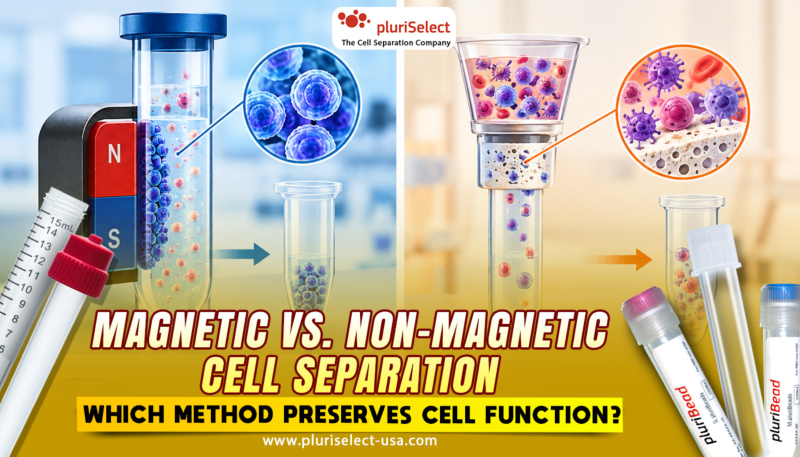
Magnetic cell separation depends on magnetic particles attached to cells and a magnetic field that can retain or move those labeled cells. This can be useful when the target population needs to be directly captured, but it also means that the workflow requires magnetic separation equipment. pluriSpin® follows a different principle. Since the target cells are not directly labeled, there is no need to make them magnetic or retain them with a magnet.
Instead, unwanted cells are identified using specific antibodies, and density gradient centrifugation is used to separate the cell populations. The separation is therefore based on the density of the cells and the surrounding medium rather than magnetic retention.
Removing the magnetic step can simplify the equipment requirements for laboratories that already use centrifugation as part of their sample-processing workflow. Researchers do not need to introduce a magnetic separation stage simply to obtain an untouched target population.
This is particularly useful when the objective is to keep the desired cells outside the direct selection process. The method focuses on removing unwanted cells rather than creating a way to capture the target cells magnetically.
Column-based separation provides another way to isolate selected cell populations. In such workflows, cells interact with a separation material inside a column, and the desired or unwanted population is retained or allowed to pass through depending on the method.
pluriSpin® does not require this type of setup. The separation takes place through density gradient centrifugation, so there is no need to pass the sample through a column. Once the unwanted cells have been targeted, centrifugation provides the physical separation needed to obtain the desired cell fraction.
This gives the workflow a different structure. Instead of preparing a column, loading the sample, and carrying out a column-based separation, researchers can use a centrifuge-based process.
For laboratories that want to avoid additional separation components, this can make the workflow more straightforward. It also means that the separation method does not depend on a column being compatible with the sample or target population. The absence of columns is therefore not simply a product feature. It reflects the underlying separation principle used by pluriSpin®.
The pluriSpin® workflow can be understood as a series of steps, with each stage serving a specific purpose. The process starts with a mixed cell sample containing the desired population and other cell types. Specific antibodies are introduced to recognize the unwanted populations. These antibodies bind to their target cells, while the cells researchers want to retain remain unbound.
The sample then undergoes density gradient centrifugation. During centrifugation, the different cell populations move according to their density in relation to the density gradient medium. This creates separated fractions from which the desired population can be recovered.
The important point is that the target cells have not been directly labeled during the selection step. Their enrichment comes from the removal of unwanted cells rather than from attaching selection particles to the target population.
This gives the complete workflow a clear sequence: identify unwanted cells, remove them through density-based separation, and recover the unbound target population.
Because the method does not require magnets or columns, the workflow remains centered on antibody-based negative selection and centrifugation.
The value of untouched cell isolation becomes clearer when considering what happens after separation.
Some experiments are designed to examine how cells behave, respond, or change under specific conditions. In these situations, researchers may prefer to start with cells that have not been directly targeted by selection particles or antibodies.
For functional studies, this can provide a useful starting population for investigating cellular responses. Similarly, researchers working with cell culture or differentiation may want the isolated cells to remain outside the direct selection process before introducing their experimental conditions. Untouched cells can also be useful when the target population will undergo additional characterization. The separation method can be selected with the downstream workflow in mind rather than treating cell isolation as an independent step.
This does not mean that every downstream application requires untouched cells. Some experiments are fully compatible with directly labeled populations, making positive selection a suitable option.
The important consideration is whether direct labeling of the target population fits the purpose of the experiment. When it does not, an untouched-cell approach such as pluriSpin® can provide an alternative.
pluriSpin® can be considered when the main requirement is to obtain a desired cell population without directly labeling it during selection. This is particularly relevant for workflows where researchers want to minimize direct interaction between the target cells and selection components. Instead of capturing the target cells, the method removes unwanted populations.
It can also be useful when researchers prefer a separation process that does not depend on magnetic equipment or columns. Since pluriSpin® uses density gradient centrifugation, laboratories can work with a centrifuge-based approach while still using antibody specificity to identify unwanted cells. The method is therefore suited to a specific combination of requirements: untouched target cells, negative selection, and a non-magnetic separation workflow.
Researchers should still consider their sample type, target population, required enrichment, and downstream application before choosing any separation method. No single approach is appropriate for every cell separation task. However, when maintaining an untouched target population is a central requirement, pluriSpin® provides a method designed specifically around that goal.
A major advantage of the pluriSpin® approach is that the separation workflow does not need to incorporate magnetic retention or a column-based step.
This keeps the process centered on two main components: specific antibody recognition of unwanted cells and density gradient centrifugation. For researchers, this can mean fewer specialized separation components to incorporate into the workflow. The target cells do not need to be magnetically labeled, and the sample does not need to pass through a separation column.
The approach also supports the goal of untouched cell isolation. Since the target cells are not the population being directly labeled, they remain outside the selection interaction. Another benefit is that the method fits naturally into laboratories already familiar with centrifugation-based sample processing. Rather than introducing a separate magnetic or column-based stage, researchers can use density-based separation to complete the isolation.
The practical value therefore comes from the combination of features rather than from any one step: negative selection identifies what should be removed, density gradient centrifugation separates the sample, and the absence of magnets and columns keeps the workflow straightforward.
Isolating untouched cells requires a separation strategy that focuses on the cells researchers want to remove rather than directly labeling the population they want to retain. pluriSpin® is designed around this negative selection principle.
Specific antibodies identify unwanted cell populations, while the desired cells remain unbound. Density gradient centrifugation then provides the physical separation needed to enrich the target population.
Because this approach does not rely on magnetic particles, magnets, or separation columns, it offers an alternative to workflows based on direct magnetic or column-based capture. The target cells remain outside the direct selection step while unwanted populations are removed.
This can be valuable for researchers whose downstream experiments require an untouched starting population. Functional studies, cell culture, differentiation, and other applications can each have different requirements, so the separation method should always be selected according to the intended use of the isolated cells.
For workflows where untouched target cells and a magnet- and column-free process are priorities, pluriSpin® provides a focused approach that combines negative selection with density gradient centrifugation.









 The Cell Separation Company