Cookie Settings
We use cookies to provide an optimal experience for you. Technically required cookies are used for making shopping possible, statistics are used for anonymized Google Analytics. You can read everything in our updated privacy policy.
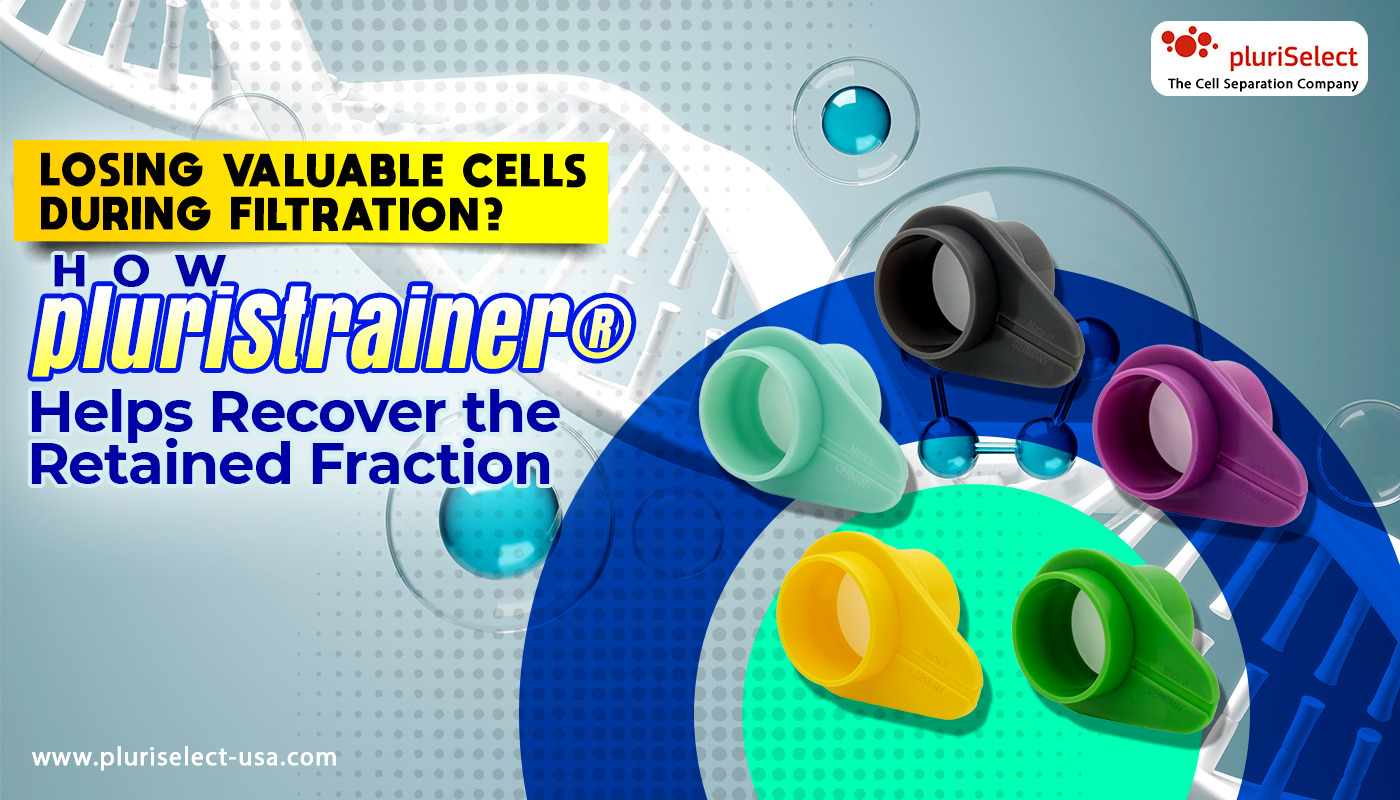
Filtration is often used to remove unwanted material, separate cell populations, or prepare a sample for downstream analysis. But what happens when the cells you need are the ones that remain on the strainer?
This can happen when target cells form clusters, when tissue fragments contain useful cells, or when the filtration step is designed to retain material within a particular size range. If the retained fraction is automatically discarded, valuable cells may be lost before the next stage of the experiment even begins. For researchers working with cell suspensions and tissue-derived samples, filtration is therefore not only about what passes through the mesh. It can also be about what remains on it and whether that material can be recovered efficiently.
pluriStrainer® is designed as a sterile sieving device for obtaining true single-cell suspensions or removing cell aggregates. Its design also allows researchers to recover material retained on the mesh, providing more flexibility when the retained fraction contains cells or clusters that are still needed.
Material retained by a strainer is not necessarily waste. A retained fraction can contain cell aggregates, clusters, tissue fragments, or other structures that include cells of interest. Whether these materials should be discarded depends entirely on the purpose of the experiment. For example, a researcher preparing a single-cell suspension may initially want to remove larger aggregates. But those aggregates may still contain viable cells that could be useful for another part of the study.
Similarly, researchers working with tissue-derived samples may find that fragments remaining on the mesh contain cells that were not released during the initial preparation. Discarding these fragments immediately could reduce the amount of usable biological material recovered from the original sample.
Retained clusters may also be the subject of the experiment. Researchers studying cell aggregation, spheroids, or other multicellular structures may want to collect and analyze these materials rather than remove them.
This changes the role of the strainer. Instead of being simply a tool for removing unwanted material, it becomes a way of dividing a sample into fractions that may each have value. Recognizing this distinction before filtration can help researchers decide how the retained material should be handled and whether a recovery step needs to be built into the workflow.
Recovering material from a filtration device can be more difficult than simply collecting the liquid that passes through. One challenge is access. Once material has accumulated on the mesh, researchers need a practical way to remove it without losing a significant portion of the retained sample.
Another issue is transfer. Cells or clusters may need to be moved from the filtration surface into another vessel for counting, culture, imaging, or additional processing. Each additional handling step can create an opportunity for material to remain behind. The physical characteristics of the retained material can also affect recovery. Loose cell clusters may be easier to collect than material mixed with tissue fragments or material that has accumulated across the mesh.
There is also the question of whether the retained material needs to remain intact. If the objective is to study clusters, excessive manipulation during recovery may not be desirable. If the goal is to obtain individual cells, researchers may instead want to process the retained material further. These differences mean that recovery cannot be treated as a one-size-fits-all step. The method should reflect what the researcher intends to do with the retained fraction.
A filtration device that allows the retained material to be accessed directly can make this part of the workflow easier to manage.
pluriStrainer® is designed for filtration of biological samples, including workflows where researchers need to obtain single-cell suspensions or remove cell aggregates.
One useful feature for recovery is that the strainer can be inverted. This provides a way to access material that has accumulated on the mesh rather than automatically treating it as waste. The ability to invert the strainer can be particularly useful when the retained fraction contains cells or clusters that need to be collected for further processing.
This also gives researchers more flexibility when planning the filtration step. They can use the mesh to separate the sample while keeping the retained material available for later recovery. The process can therefore be adapted depending on the experimental objective. If the retained fraction is unwanted, it can be removed. If it contains valuable material, it can instead be recovered and transferred for additional work.
pluriStrainer® can also be combined with a Connector Ring when low pressure is needed to support filtration. This can help researchers manage samples where additional support is required during the filtration step while retaining the option of recovering material from the mesh. The overall benefit is greater control over both sides of the filtration process: the fraction that passes through and the fraction that remains behind.
Mesh selection is normally discussed in terms of what should pass through the strainer. However, when retained material needs to be recovered, researchers should also consider what is likely to collect on the mesh. A mesh that retains a large amount of material can create a substantial retained fraction. If that material is important, the recovery process should be considered before the filtration begins.
The appropriate mesh depends on the intended separation. Researchers may want to remove larger aggregates while allowing individual cells to pass, or they may intentionally retain clusters for further analysis. pluriStrainer® is available in several mesh sizes, including 5, 10, 20, 40, 70, 100, and 200 µm. This range gives researchers options for matching the filtration point to the sample and the desired outcome.
The important consideration is not simply choosing a finer or coarser mesh. Researchers should think about the complete workflow:
What needs to pass through?
What needs to remain on the mesh?
Will the retained fraction be discarded or recovered?
What will happen to the recovered material?
Does the filtration step need to produce a single-cell suspension or preserve larger structures?
Answering these questions can help researchers select a filtration setup that supports both separation and recovery.
Not all retained fractions are the same, and the recovery approach may depend on what has accumulated on the mesh. Cell aggregates are one example. If clusters are being removed from a suspension, researchers may want to recover them for separate analysis rather than discard them.
Tissue fragments present another situation. A tissue-derived sample may contain pieces that remain on the strainer while individual cells pass through. These fragments can potentially contain additional cells that may be relevant to the experiment.
Larger cell clusters can also be important when researchers are studying how cells behave in groups rather than as individual cells. In these cases, the retained fraction may represent the main experimental material.
There may also be situations where the retained material needs to be processed further. Researchers may recover the fraction and then dissociate it, culture it, examine it under a microscope, or perform another analysis.
The key point is that filtration does not automatically define the value of a fraction. The same material that is unwanted in one experiment may be the target in another. By keeping the retained fraction accessible, researchers have more options for deciding what to do with it after filtration.
If recovery is an important part of the experiment, it should be considered when the filtration workflow is designed rather than added at the end. The first step is to define the purpose of filtration. Researchers should determine whether they are trying to remove unwanted material, prepare a single-cell suspension, collect clusters, or divide the sample into different fractions.
Next, they can consider how the retained material will be handled. If it needs to be recovered, the filtration setup should allow easy access to the mesh and provide a practical way to transfer the material to the next vessel.
Sample loading also matters. Processing a sample in manageable amounts can help researchers monitor how much material is being retained and avoid unnecessarily heavy accumulation on the mesh. The recovery vessel should also be prepared before filtration begins. Having the receiving container and any required downstream materials ready can reduce delays between filtration and recovery.
For workflows involving valuable or limited samples, these small planning steps can make a meaningful difference. The objective is to avoid treating recovery as an emergency step after the filtration has already been completed. Instead, recovery becomes part of the experimental design.
Retained cell recovery can be relevant in several types of research workflows.
When preparing a single-cell suspension, researchers may filter out aggregates or larger fragments. If those retained structures contain cells that need to be studied separately, they can be recovered instead of discarded.
Researchers studying cell aggregation may specifically need access to the material retained on the mesh. Recovering these clusters allows them to examine their size, structure, composition, or behavior in downstream experiments.
Samples prepared from tissues can contain both individual cells and larger fragments. Filtering can help separate these components, while recovery provides an opportunity to examine material that remains associated with the retained fraction.
When working with multicellular structures, the retained material may be the primary experimental interest. Recovering clusters from the mesh can allow researchers to continue with imaging, analysis, culture, or further processing.
Sometimes the retained material is not the main focus but still contains information or cells that researchers do not want to lose. Recovering it can provide an additional fraction for comparison or characterization.
Across these applications, the main principle remains the same: researchers should decide the value of the retained fraction before deciding whether it should be discarded.
Good recovery starts with planning. Before filtration, researchers should identify whether the material retained on the mesh is likely to have downstream value. Selecting an appropriate mesh is an important part of this process. A mesh should provide the required separation without creating an unnecessarily large retained fraction.
Researchers should also avoid treating the filtration step as complete as soon as the liquid has passed through. If the retained material is needed, the recovery step should follow as part of the same workflow. Preparing the receiving vessel in advance can make recovery more efficient. It can also help reduce the time that recovered cells spend waiting between filtration and the next processing step.
Gentle handling may be important when the retained fraction contains fragile clusters or structures that need to remain intact. The appropriate handling method will depend on the experimental objective. For repeated workflows, laboratories can also establish a consistent recovery procedure. Using the same sequence of filtration, access, transfer, and downstream processing can help reduce differences between samples.
Most importantly, researchers should distinguish between a fraction that is unwanted and a fraction that has simply been separated. Filtration does not make the retained material useless. Its value depends on the purpose of the experiment.
Filtration can improve sample preparation, but it can also result in the loss of valuable cells when everything retained on the mesh is automatically discarded. Cell aggregates, clusters, tissue fragments, and other retained structures may contain cells that researchers still need to analyze or process. For this reason, a useful filtration workflow should consider both the material that passes through and the material that remains behind.
pluriStrainer® provides researchers with a practical way to manage this retained fraction. Its sterile design supports cell suspension preparation and aggregate removal, while its ability to be inverted makes it possible to recover material collected on the mesh.
The choice of mesh should also be made with recovery in mind. Researchers can consider what needs to pass through, what needs to be retained, and what will happen to each fraction afterward. When recovery is built into the filtration workflow from the beginning, researchers have greater control over their samples and more opportunities to make use of valuable biological material.
Instead of viewing the strainer as the point where unwanted material ends up, researchers can treat it as a separation point where different sample fractions become available for the next stage of the experiment.







 The Cell Separation Company