Cookie Settings
We use cookies to provide an optimal experience for you. Technically required cookies are used for making shopping possible, statistics are used for anonymized Google Analytics. You can read everything in our updated privacy policy.
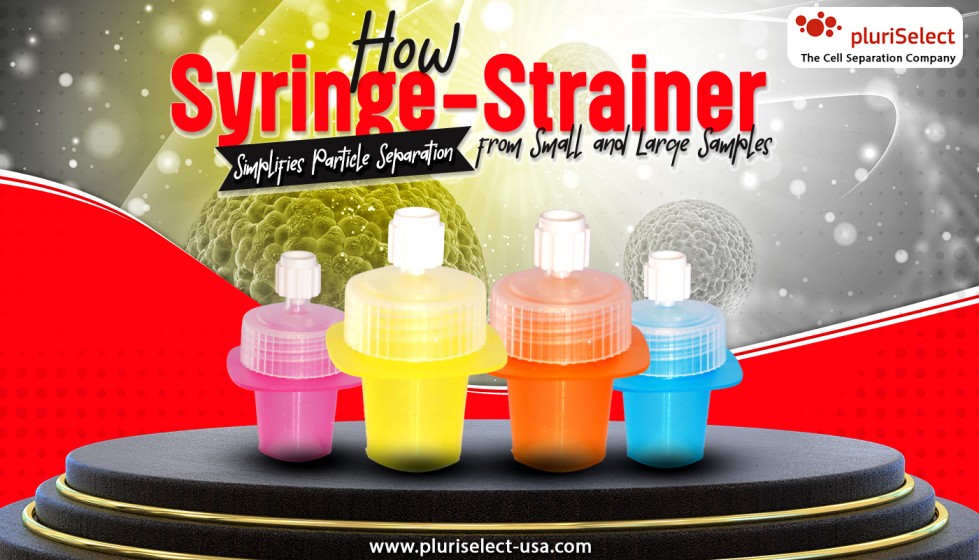
Particle separation is a step in laboratory workflows. Researchers often need to remove, collect, concentrate or examine particles that're present in a liquid. Not every sample comes in the volume or has the same makeup. One day a researcher might work with an amount using a syringe. The day they could be handling a much larger volume. Using a filtration method, for each of these situations can make sample preparation more complicated. It also takes up time and effort.
An adaptable setup can help laboratories deal with these differences without changing the basic filtration principle. The Syringe-Strainer is designed for this kind of flexibility. It can be attached directly to a syringe. Connected to a tube through its screw cap with a Luer-Lock port. This means it can be used for samples as well as larger volumes depending on how the filtration system is set up.
Pressure also matters a lot. The Syringe-Strainer can work with either negative pressure. This gives researchers control over how the liquid moves through the mesh. Positive pressure can push the sample through the strainer. Negative pressure can pull liquid through it. Help recover particles after filtration. Another important factor is particle size. The Syringe-Strainer comes in 15 mesh sizes ranging from 1 µm to 500 µm. This wide range lets researchers pick the mesh, for the particles they want to keep or remove.
The amount of a sample usually decides how filtration should happen. The Syringe-Strainer can be used for both large sample amounts:
For small-volume samples: The Syringe-Strainer can be connected directly to a syringe using its Luer-Lock connection. The sample is pushed through the mesh letting liquid go through while keeping particles that're bigger than the mesh openings.
Simple handling of limited samples: When only a small amount of sample is available the syringe can act as both the sample holder and the pressure source. This means there is no need for containers or a bigger filtration system.
For larger sample volumes: The Syringe-Strainer can be attached to tubing. Used with a pump. This makes it possible to move amounts of liquid through the strainer without having to fill and use a syringe multiple times.
Different ways to move the sample: With small samples, the syringe provides the pressure required for filtration. For larger samples, tubing and a pump can support a more continuous flow through the strainer.
Positive pressure filtration: Positive pressure pushes the liquid toward and through the mesh. This can be useful when the main goal is to move the sample through the strainer efficiently.
Negative pressure filtration: Negative pressure draws liquid through the mesh. It can also be useful when the workflow requires recovery of retained particles after filtration.
One setup for different sample scales: Laboratories handling both small and large samples can adapt the Syringe-Strainer by changing how the sample is connected and moved through the device rather than using completely different filtration methods.
Adapt the setup to the desired fraction: If the filtered liquid is the main material of interest, the workflow can focus on efficient passage through the mesh. If the retained particles are the target, the setup should be planned around their retention and recovery.
Consider more than sample volume: Sample volume is only one factor in choosing a filtration approach. Particle size, selected mesh, pressure, and the intended downstream use should also be considered when designing the workflow.
Mesh selection is one of the most important decisions in particle separation. The mesh determines which particles are retained and which particles pass through with the liquid. Choosing the wrong size can result in unwanted particles passing through or a filtration process that is unnecessarily difficult to manage. The Syringe-Strainer comes in 15 mesh sizes that go from 1 µm to 500 µm. This offers researchers a selection when dealing with particles of various sizes. A finer mesh is a choice when smaller particles need to be kept. For example a 1 micrometer mesh has holes compared to a 100 micrometer mesh or a 500 micrometer mesh. Larger particles that do not fit through the mesh stay behind while smaller particles and the liquid move through. A coarser mesh can help when the goal is to get rid of particles or dirt while letting smaller material pass through. This might be better when a sample has a mix of particle sizes and the researcher wants the part. The main thing is to begin with the goal of the separation of just picking the finest mesh available. A smaller mesh is not always the choice. If a sample has a lot of material that's much bigger than the particles needed a very fine mesh might get filled up with material that is not wanted before the separation is done. Imagine a sample that has big debris and smaller particles that need to be gathered. Using a fine mesh right away might cause the big debris to build up on the filter surface. Selecting a more suitable mesh based on the sample composition can help manage the larger material and make the overall separation more practical.
Mesh choice also depends on whether the researcher wants to retain particles or remove them. These are related but different goals. If the objective is to collect particles that are larger than a set size the mesh must keep those particles. If the aim is to get rid of particles from a liquid while letting small particles pass the same mesh is used for a different job. This difference matters a lot when we plan what comes next. A batch of particles that stays on the mesh might need to be looked at under a microscope, counted, described or used in another lab test. In those moments the mesh must be chosen not for how well it filters, but also for how well it splits the required group of particles for the next step. The Syringe‑Strainer offers a range of mesh sizes so scientists can adjust the split to fit each need. Of always using one fixed mesh, for every sample labs can pick a mesh that matches the particle size and the purpose of each workflow.
Filtration is often seen as a step in preparing a sample.. That is not always true. In work routines the particles that stay on the mesh are actually the material that researchers want to examine. Filtration in these cases becomes part of the investigation. The mesh holds the particles that carry the information. Researchers then study those particles carefully. Filtration therefore is not a routine task; it is a crucial part of the whole research process. After filtration finishes the next task becomes getting those particles without making the process too hard. The Syringe-Strainer helps with this kind of routine by letting the retained material be taken out after filtration. Syringe-Strainer is very useful when the particles themselves are valuable for study. During filtration particles larger than the chosen mesh openings stay on the strainer while the liquid goes through. If the retained fraction has to be collected using pressure can help with a backwashing step. This allows the retained particles to be moved away from the mesh and recovered through the screw cap into a syringe.
This recovery approach changes the way filtration is used. Of just being a way to take particles out of a liquid the strainer can be part of a bigger process for separating and recovering materials. For example a researcher might start with a sample that has a mix of particles. The sample goes through the chosen mesh letting the liquid and smaller particles go through while the larger particles stay on the mesh. After filtering the material that is left can be taken out for study. This can be helpful when getting the particles back is more important than getting clear liquid.
The ability to recover retained material can also reduce unnecessary sample handling. Then taking out the strainer and using another tool to move the material from its surface the recovery process can be part of the same system. This can help keep the work flow organized. Downstream processing needs should therefore be thought about before filtration starts. Scientists should think about what they want to do with the material after it is separated. If the liquid that passed through the mesh is what is needed the system can be arranged to make that process as smooth, as possible. If the particles that remain on the mesh are what is needed, selecting the mesh and thinking about how to retrieve the particles should be done together.
Sample volume also affects this planning. A small sample can be filtered directly using a syringe. Collected through the same compact setup. For samples, tubing and a pump can handle the filtration step while the retained fraction remains available after the process. This means the Syringe-Strainer works well in workflows where particle separation comes before steps. The filtration stage doesn’t need to stand. It can be linked right into the part of sample processing. For researchers dealing with precious particle fractions this method is especially helpful. Losing retained material during transfer can affect the amount available for analysis. Building recovery into the filtration workflow from the beginning can help researchers make better use of the collected fraction.
Separating particles is harder when labs have to work with samples that vary a lot in size. A set up that works for a sample may not work for several liters. A big filtration system may be too much for an amount. The Syringe-Strainer gives a solution that can adapt to both cases. For a sample the Syringe-Strainer can be attached directly to a syringe through its Luer-Lock connection. For a quantity the Syringe-Strainer can be connected to tubing and used with a pump to allow continuous filtration.
Choosing the pressure adds more flexibility. Positive pressure can push liquid through the mesh while negative pressure can pull liquid through the Syringe-Strainer and help recover particles that stay in the mesh when needed. The mesh is central to the process. The Syringe-Strainer has 15 mesh sizes that range from 1 µm, to 500 µm. The Syringe-Strainer can match a mesh to the size of particles that need to be separated. Choosing the mesh that fits the target fraction of simply picking the smallest opening can make the filtration workflow more practical.
Perhaps the important thing is that the process doesn't have to stop once the liquid goes through the strainer. When the particles that are left behind are the thing you want, the Syringe-Strainer can help you get them back by using a method called backwashing with pressure. For labs that work with amounts of samples and different kinds of particles this ability to change things up can make preparing samples much easier. By making a completely new way to filter everything scientists can change the syringe, the tubes, the pressure and the mesh based on what they need for their work.
The end result is a way to separate particles that can go from handling amounts of sample to dealing with bigger amounts while keeping the main idea the same. For scientists who want both the ability to change things and the power to control the parts they are working with, the Syringe-Strainer offers a solution that brings filtering, separating and getting the particles back all into one process.






 The Cell Separation Company