Cookie Settings
We use cookies to provide an optimal experience for you. Technically required cookies are used for making shopping possible, statistics are used for anonymized Google Analytics. You can read everything in our updated privacy policy.
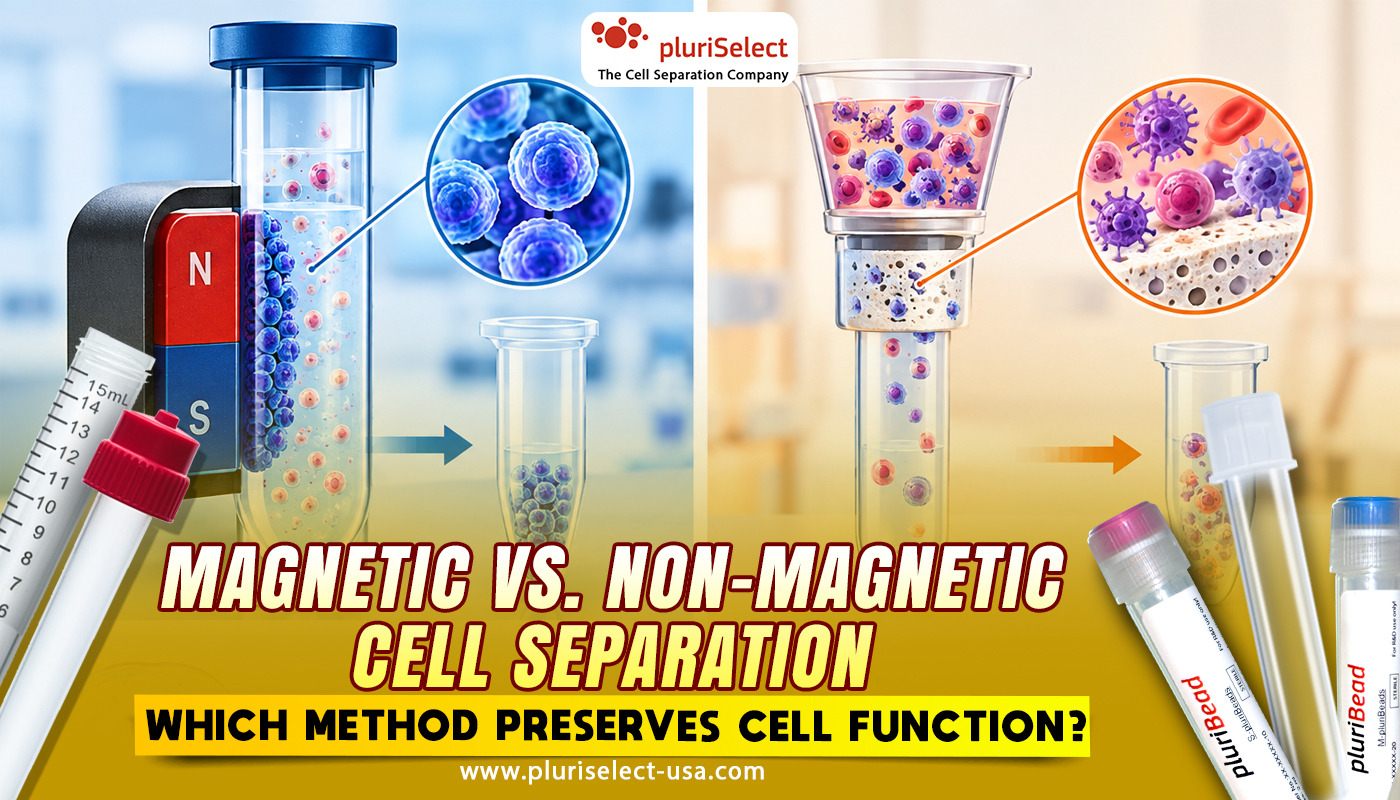
Cell separation is often treated as a preparation step, but what happens during isolation can matter just as much as the purity of the final cell population. Researchers may need isolated cells for functional assays, cell culture, differentiation studies, molecular analysis, or other downstream applications. In these cases, simply obtaining the correct cells is not enough. The cells also need to remain suitable for the work that follows.
This is why the choice between magnetic and non-magnetic cell separation deserves careful consideration.
Both approaches can enrich specific cell populations, but they use different principles. Magnetic methods generally involve labeling cells with magnetic particles so that a selected population can be separated using a magnetic field. Non-magnetic methods can use other properties, such as cell density, to separate populations without introducing magnetic particles. The distinction becomes especially important when researchers want to study cells in a state that is as close as possible to their starting condition.
For some applications, direct labeling of the target cells is acceptable. For others, researchers may prefer to avoid direct interaction with selection particles or antibodies. Understanding this difference can help determine which method is more suitable for preserving cell function.
Magnetic cell separation is based on the interaction between labeled cells and a magnetic field. The process generally starts by identifying a marker associated with the cell population of interest. Antibodies designed to recognize that marker are attached to magnetic particles. When the particles bind to the target cells, those cells become magnetically responsive.
The labeled cells can then be separated from the rest of the sample using a magnetic separation system. Depending on the selected approach, researchers may either retain the labeled target cells or use magnetic labeling to remove unwanted populations.
One of the main advantages of this method is its ability to target a defined cell population. When suitable markers are available, magnetic separation can provide an efficient way to enrich cells from a mixed sample. Magnetic separation is therefore widely used in workflows where researchers need a particular cell type and direct labeling is compatible with the intended application.
However, the labeling step is an important consideration when the biological condition of the target cells matters. If the target population is directly exposed to antibodies or magnetic particles, researchers need to consider whether this interaction is appropriate for their downstream work.
That does not make magnetic separation unsuitable. Rather, it means that the method should be selected according to what researchers need to do with the cells after isolation.
Non-magnetic cell separation uses a different basis for separating cell populations. Instead of relying on magnetic particles and a magnetic field, these methods can use physical or biological differences between cells. Density-based separation is one example. In this approach, cells are separated according to differences in density using a density gradient medium and centrifugation. Different components of a sample move to different positions during centrifugation, allowing a desired cell fraction to be collected.
Another important approach is negative selection. Rather than labeling the target cells, antibodies are used to identify unwanted populations. These unwanted cells are removed, while the desired cells remain unbound.
This distinction is particularly relevant when researchers want an untouched target population. With a non-magnetic negative selection workflow, the cells of interest do not need to carry magnetic particles because they are not the cells being targeted. Instead, the selection process focuses on what needs to be removed.
The result is a different type of starting material for downstream experiments. Researchers can obtain an enriched population without directly labeling the cells they intend to study. Non-magnetic methods can therefore be useful when maintaining the target population without magnetic labeling is an important consideration.
Cell function can be influenced by several aspects of the isolation process, so it is important not to judge a separation method by its name alone.
One consideration is direct interaction with the target cells. If antibodies or particles bind directly to the cells of interest, researchers may need to consider whether that interaction could affect the intended downstream application. The type of cell also matters. Different populations can respond differently to handling and experimental conditions. A method that works well for one application may not be the best choice for another.
Physical processing is another consideration. Sample preparation, incubation, centrifugation, washing, and recovery all contribute to the overall workflow. The more handling a cell population undergoes, the more important it becomes to use conditions appropriate for that cell type and application.
Researchers should therefore consider what they mean by “preserving cell function.” For one experiment, it may mean maintaining viability. For another, it may mean retaining the cells' natural surface characteristics or their ability to respond normally in a functional assay. This is why the downstream application should be considered before selecting the separation method.
If the experiment specifically requires cells that have not been directly labeled or bound by selection reagents, an untouched-cell approach may offer a practical advantage.
Magnetic separation offers a direct and practical way to enrich defined cell populations. By selecting markers associated with the target cells, researchers can use magnetic particles to isolate the population they need from a complex sample.
This direct targeting can be useful when the selected cells are intended for applications where magnetic labeling does not create a problem.
For example, when the primary objective is obtaining a specific enriched population quickly and the downstream application is compatible with the selection process, magnetic separation can be an effective choice. However, researchers should look beyond the efficiency of isolation when cell function is a key requirement.
When the target cells are positively selected, magnetic particles are attached to those cells during the separation process. The presence of these selection components may need to be considered when planning downstream experiments, particularly when researchers want the cells to remain untouched. This does not mean that magnetic separation automatically damages or changes cell function. The suitability depends on the specific separation system, cell type, labeling conditions, and downstream application. The key question is whether direct interaction with the target cells is acceptable for the experiment. If it is, magnetic separation can be a useful option. If the goal is specifically to obtain target cells without directly labeling them, researchers may want to consider a non-magnetic negative selection approach instead.
When researchers need cells that remain free from direct selection labels, non-magnetic separation can offer an important advantage. Instead of attaching particles to the target population, the separation can be designed to leave those cells unbound.
This is particularly relevant for experiments that examine how cells behave after isolation. If the target cells are intended for functional testing, culture, stimulation, or differentiation, researchers may prefer to start with cells that have not been directly targeted during the separation process.
Negative selection provides one way to achieve this. Antibodies identify unwanted cell populations rather than the cells researchers want to keep. The unwanted populations are then removed, leaving the desired cells behind.
The advantage is not simply the absence of magnetic particles. It is the fact that the target population is not the focus of the labeling step. This makes untouched-cell separation useful when researchers want to minimize direct manipulation of their cells of interest. It can provide an enriched population while allowing researchers to carry out their downstream experiments on cells that have remained unbound throughout selection.
The distinction between positive and negative selection is important when evaluating how a separation method may fit a functional cell study.
Positive selection identifies the target cells directly. Selection antibodies or particles bind to markers on the cells of interest, allowing those cells to be captured and separated from the rest of the sample. Negative selection reverses this process. Instead of targeting the desired population, the method identifies unwanted cells. These populations are removed, while the target cells remain outside the selection process. The choice between the two depends on the purpose of the experiment.
If researchers primarily need a specific enriched population and direct labeling is acceptable, positive selection can be appropriate. It provides a direct route to capturing the cells of interest.
If researchers specifically want an untouched population, negative selection has a practical advantage. The target cells are not directly labeled with the selection components used to remove unwanted cells.
This distinction can be especially useful for functional studies. Researchers can choose a separation strategy based not only on how efficiently cells can be enriched, but also on how closely the isolated population needs to reflect its starting condition.
pluriSpin® is designed for negative cell selection when researchers need an untouched target population. Rather than binding selection reagents to the cells researchers want to isolate, the method uses specific antibodies to identify unwanted cells. The desired cells remain unbound while the unwanted populations are separated from the sample. This approach removes the need to directly target the cells of interest during selection.
pluriSpin® also uses density gradient centrifugation rather than magnets or columns. This provides a non-magnetic approach to cell separation and makes the method suitable for workflows where researchers want to avoid magnetic separation of their target cells. The combination of negative selection and density-based separation gives researchers a way to enrich their desired population while keeping it outside the direct labeling step.
This can be useful when the isolated cells are intended for downstream applications where their condition after separation matters. Instead of modifying the target cells so they can be captured, the process removes the populations that are not required.
For researchers focused on untouched cell isolation, this difference is central to the value of the approach.
The best separation method depends heavily on what researchers plan to do with the isolated cells afterward.
For functional assays, maintaining the target population in an untouched state may be particularly important. Researchers may want to examine cellular responses without having directly targeted the cells during isolation.
Cell culture and differentiation studies can also benefit from carefully considering the selection method. When the behavior of the isolated cells is itself part of the experiment, the way those cells were prepared can become an important part of the experimental design.
For flow cytometry or molecular analysis, the requirements may be different. Researchers may prioritize a defined population, purity, recovery, or compatibility with the specific analytical workflow. This means there is no universal answer to whether magnetic or non-magnetic separation is better. The correct choice depends on the relationship between the separation method and the intended downstream work.
When untouched cells are specifically required, however, a non-magnetic negative selection method can be a strong fit because it avoids directly targeting the population researchers want to study.
Cell function is important, but it should not be the only factor considered when selecting a separation method.
Researchers should first look at the starting sample and determine which cell populations need to be isolated or removed. The availability of suitable markers can influence whether positive or negative selection is practical. Purity and recovery are also important. A method needs to provide a cell population that is suitable for the intended experiment, while producing enough material for downstream work.
Workflow requirements should also be considered. Magnetic separation requires the appropriate magnetic equipment, while non-magnetic approaches may rely on other separation principles, such as centrifugation. The amount of hands-on work can also differ between methods. Sample preparation, labeling, washing, separation, and recovery all contribute to the total workflow.
For this reason, method selection should involve more than asking which technology provides the highest enrichment. Researchers should consider the entire process and how well it fits their laboratory setup.
Magnetic separation is a useful option when researchers want to directly target and enrich a defined cell population. Its strength lies in its ability to use specific cell markers to capture the cells of interest.
Non-magnetic separation provides other options, including density-based separation and negative selection. These approaches can be useful when direct labeling of the target cells is not desirable. The most important difference for functional applications is therefore how the target population is treated during isolation.
With positive magnetic selection, the cells of interest are directly involved in the labeling process. With negative selection, the unwanted cells are targeted instead, allowing the desired population to remain unbound.
Researchers should also consider the equipment available, sample type, required enrichment, target-cell characteristics, and downstream application.
There is no single separation method that is ideal for every experiment. The right approach is the one that meets the requirements of both the isolation step and the work that follows.
Magnetic and non-magnetic cell separation methods can both provide enriched cell populations, but they differ in how they interact with the cells being isolated. Magnetic separation can be highly useful when direct targeting of the desired population is acceptable. However, when researchers need an untouched population, the selection strategy becomes especially important.
Negative selection offers a different approach by targeting unwanted cells rather than the target population. This allows the desired cells to remain unbound during separation, making the method well suited to applications where preserving the target population's starting state is a priority. pluriSpin® follows this principle by combining negative selection with density gradient centrifugation. The approach does not require magnets or columns and is designed to enrich target cells while leaving them untouched by the selection reagents.
Ultimately, preserving cell function depends on the requirements of the specific experiment. Researchers should consider the cell type, separation objective, downstream application, and handling requirements before choosing a method. When untouched target cells are central to the workflow, non-magnetic negative selection provides a clear practical advantage.









 The Cell Separation Company