Cookie Settings
We use cookies to provide an optimal experience for you. Technically required cookies are used for making shopping possible, statistics are used for anonymized Google Analytics. You can read everything in our updated privacy policy.
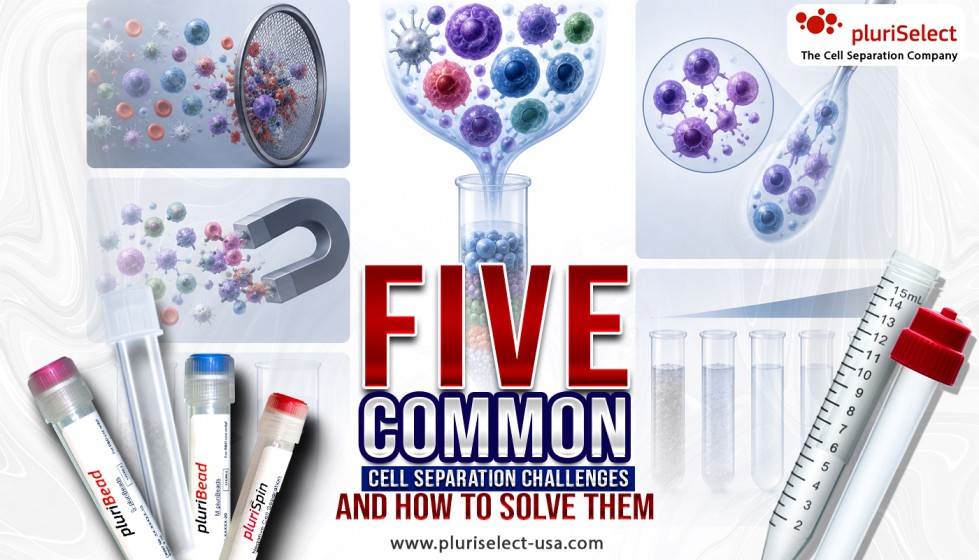
Cell separation is a fundamental step in many areas of life science research, including immunology, molecular biology, regenerative medicine, diagnostics, and biotechnology. Whether researchers are isolating immune cells from blood, preparing single-cell suspensions from tissue, or enriching specific cell populations for downstream analysis, the quality of the separation process directly influences the quality of the final results.
Although numerous technologies are available today, cell separation is rarely as simple as processing a sample through a single device. Laboratories often encounter challenges that affect cell recovery, purity, viability, and workflow efficiency. Issues such as sample debris, cell loss, contamination, excessive handling, and difficulties in scaling workflows can all reduce the reliability of experimental outcomes.
Fortunately, many of these challenges can be addressed by selecting the appropriate separation technology and following a well-designed workflow. Size-supported filtration, gravity-supported separation, and antibody-supported cell isolation each solve different problems and often work best when used together.
In this article, we explore five of the most common cell separation challenges and discuss practical solutions that help researchers achieve cleaner samples, higher-quality cell populations, and more consistent experimental results.
The success of any cell separation workflow begins with the quality of the starting sample. Samples collected from tissue, blood, bone marrow, or cultured cells often contain unwanted materials that can interfere with downstream processing.
Common problems include:
Tissue fragments
Cell aggregates
Large particles
Dead cells
Extracellular debris
If these materials are not removed before separation, they can clog filtration devices, reduce separation efficiency, and increase variability between samples. Aggregates may also trap target cells, reducing overall recovery and making downstream analysis more difficult.
The best solution is to prepare a clean, uniform sample before beginning cell isolation. Size-supported filtration removes unwanted debris while preserving the cells of interest. Different filtration tools can be selected according to sample type and volume.
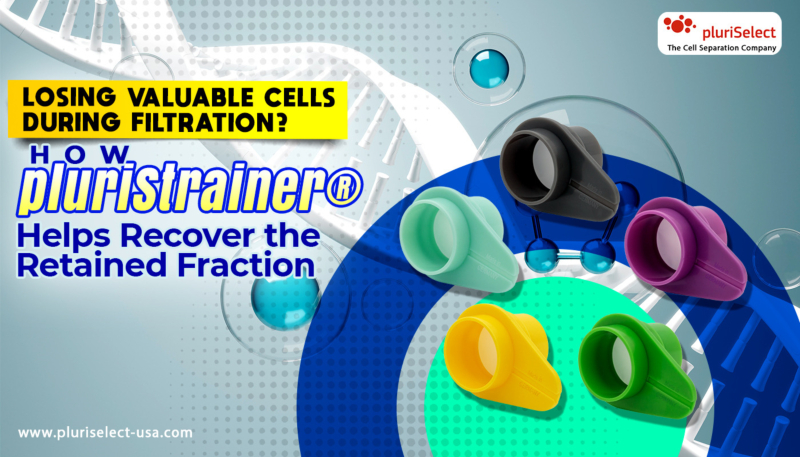
The Mini Strainer is well suited for filtering small-volume samples while minimizing sample loss. When researchers need greater stability during miniature filtration workflows, the Mini-Strainer-Aid improves pipette handling and makes processing more consistent. For routine laboratory filtration, the pluriStrainer provides multiple mesh sizes that support tissue dissociation, debris removal, and preparation of single-cell suspensions. Small-volume workflows can also benefit from the Pipette-Strainer, which integrates filtration directly into pipetting procedures. By combining pipetting and filtration into one step, it simplifies handling and reduces unnecessary sample transfers.
The SnapCap Strainer further streamlines sample preparation by combining the filtration mesh and collection tube into one device. Available with sterile nylon meshes in commonly used pore sizes, it allows researchers to remove debris while reducing contamination risk and sample loss. Investing time in proper sample preparation creates a stronger foundation for every subsequent separation step.
Recovering an adequate number of target cells is one of the primary goals of every cell separation workflow. Even when purity is high, poor recovery can limit downstream experiments, particularly when working with rare cell populations or valuable clinical samples.
Several factors contribute to low recovery, including repeated transfers between tubes, unnecessary handling, inefficient filtration, and incomplete collection of enriched cells. Small losses at each step may seem insignificant, but together they can substantially reduce the final yield.
Limited sample availability makes this challenge even more important. Researchers working with small blood samples, biopsy material, or precious research specimens cannot afford unnecessary cell loss.
One of the most effective strategies is to simplify the workflow by reducing the number of processing steps. Integrated filtration devices help minimize transfers between containers, lowering the opportunity for valuable cells to remain behind on pipette tips, tube walls, or filtration devices.
The SnapCap Strainer supports this approach by combining filtration and sample collection within a single unit, helping reduce handling while improving workflow efficiency. For standard laboratory filtration, the pluriStrainer allows efficient processing of samples while supporting high cell recovery across different mesh sizes. Blood-derived samples can also benefit from simplified density gradient workflows. The TwinSpin® system combines density gradient centrifugation with precise collection of enriched cells. Its unique dual-tube design allows target cells to remain above the density gradient while unwanted cells migrate below, making collection easier and helping reduce recovery losses.
Reducing unnecessary handling not only improves recovery but also shortens processing time and contributes to more reproducible laboratory workflows.
Obtaining a sufficient number of cells is only part of successful cell separation. The isolated population must also be as pure as possible for downstream applications. Contamination from unwanted cells can interfere with flow cytometry, molecular analysis, functional assays, and cell culture experiments. Common examples include:
Granulocyte contamination in PBMC preparations
Residual red blood cells
Mixed leukocyte populations
Platelet contamination
Tissue debris carried into downstream workflows
Poor purity often results in additional processing steps, increased variability, and more difficult interpretation of experimental data.
Improving purity begins with selecting the correct separation strategy for the sample being processed. For blood-derived samples, choosing an appropriate density gradient medium is essential. Different media are formulated for different target cell populations, helping improve separation efficiency while reducing unwanted carryover. Technologies such as pluriMate® simplify density gradient centrifugation by incorporating a porous barrier that minimizes mixing between the blood sample and density gradient medium. This helps produce cleaner interfaces and facilitates collection of enriched cell populations.
Similarly, TwinSpin® improves the collection process through its dual-tube design, allowing researchers to recover enriched cells with greater precision while reducing disturbance of adjacent cell layers. In situations where additional purification is required, pluriSpin® provides a negative cell isolation strategy. Rather than labeling the desired cells, it removes unwanted cell populations during density gradient centrifugation, leaving the target cells untouched and enriched for downstream applications.
Combining effective sample preparation, an appropriate density gradient medium, and targeted purification methods helps laboratories obtain cleaner cell populations while reducing the need for repeated processing.
High purity and good recovery are valuable outcomes, but they alone do not guarantee successful research. The isolated cells must also remain healthy and function as they would under normal biological conditions. If the separation process places excessive stress on the cells, downstream applications such as cell culture, immune response studies, and molecular analysis may be affected.
Several factors can influence cell viability during separation, including repeated centrifugation, multiple washing steps, extensive pipetting, and prolonged processing times. Direct labeling of target cells may also not be suitable for experiments where maintaining natural cell characteristics is important.
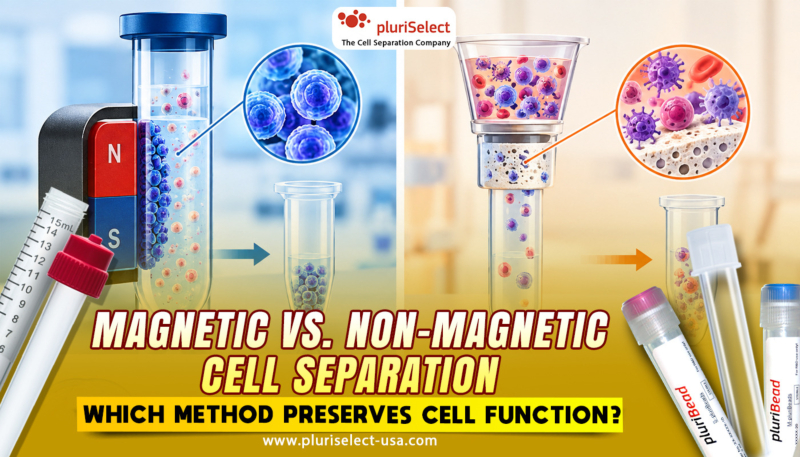
Maintaining cell viability begins with selecting separation methods that minimize unnecessary handling while preserving the biological integrity of the target cells. Negative cell isolation is particularly valuable because it removes unwanted cells instead of directly capturing the desired population. Since the target cells remain untouched, they retain their natural phenotype and remain suitable for sensitive downstream applications.
The pluriSpin® platform follows this approach by combining negative cell isolation with density gradient centrifugation. Unwanted cells are selectively labeled and removed during centrifugation, while the desired cells remain enriched at the density gradient interface without direct labeling.
This strategy offers several advantages:
Preserves natural cell characteristics
Supports high cell viability
Maintains surface marker availability
Simplifies downstream staining and analysis
Integrates with standard density gradient protocols
Requires no magnets or separation columns
In addition to selecting an appropriate separation method, researchers should process samples promptly, avoid excessive centrifugation, and use recommended buffers and centrifugation settings to help maintain healthy cell populations throughout the workflow.
A workflow that performs well with a few milliliters of sample may become inefficient when laboratories begin processing larger volumes or increasing sample throughput. Scaling cell separation involves more than simply handling additional material. Researchers must also maintain consistent recovery, purity, and reproducibility across every sample.
As sample numbers increase, laboratories often face new challenges, including:
Longer processing times
Greater workflow variability
Increased handling requirements
Higher consumable usage
Difficulty maintaining consistent filtration performance
Without standardized methods, these factors can introduce unwanted variation between experiments.
Successful scale-up begins with technologies designed to support larger workflows without significantly changing established laboratory procedures.
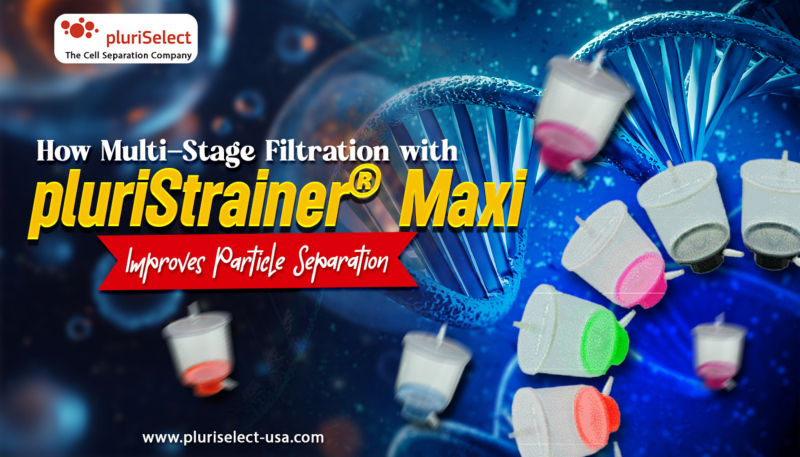
The pluriStrainer® Maxi addresses this need by enabling large-volume filtration using a bottle-top format. It supports filtration volumes ranging from hundreds of milliliters to several liters, making it well suited for laboratories transitioning from small research projects to larger studies or production-oriented workflows. For workflows involving continuous liquid movement, the In-Line-Strainer allows filtration to occur without interrupting sample flow. This can improve efficiency while reducing manual handling during larger processing operations.
Standardized protocols are equally important. Using consistent centrifugation conditions, appropriate filtration devices, and validated sample preparation procedures helps laboratories maintain reproducible results regardless of sample volume.
By planning scalability early, researchers can expand their workflows with greater confidence while maintaining the quality established during smaller studies.
Many common cell separation challenges can be minimized through thoughtful workflow design. Rather than focusing on a single isolation step, researchers should consider the complete process from sample preparation through downstream analysis.
Several practical strategies can help improve overall performance.
Different sample types require different separation methods. Tissue samples, whole blood, cultured cells, and bone marrow each present unique processing requirements. Selecting the most appropriate technology at the beginning of the workflow improves both efficiency and recovery.
Mesh size should be selected according to the characteristics of the sample and the desired outcome. Using an appropriate filtration device helps remove unwanted particles while preserving valuable cells.
For blood-derived samples, the density gradient medium plays an important role in determining separation quality. Choosing a medium formulated for the target cell population helps improve purity and reduce contamination.
Every additional transfer, wash, or processing step increases opportunities for cell loss and variability. Streamlined workflows help preserve both recovery and viability.
Using consistent protocols across operators and experiments improves reproducibility and simplifies workflow validation as projects grow.
Following these best practices allows laboratories to build efficient workflows that support reliable research outcomes across a wide range of applications.
At pluriSelect, we develop technologies that support every stage of the cell separation workflow, from initial sample preparation to highly specific cell isolation.
Researchers choose our solutions because we provide:
Our portfolio includes size-supported filtration systems, gravity-supported separation technologies, antibody-supported cell isolation products, and density gradient media that work together as part of an integrated workflow.
Each product is designed to address specific laboratory challenges while remaining easy to incorporate into routine research procedures.
Whether processing small research samples or larger production volumes, our products support changing laboratory requirements without compromising workflow quality.
All products are manufactured according to strict quality standards, helping laboratories achieve consistent and reproducible results.
As a biotechnology company specializing in cell and protein separation, we continue to work closely with researchers worldwide to develop practical solutions for modern laboratory workflows.
Cell separation is a multi-step process, and the quality of each stage influences the success of the next. Challenges such as poor sample quality, low cell recovery, unwanted contamination, reduced viability, and workflow scalability can all affect downstream research if they are not addressed early.
Fortunately, these challenges can often be overcome by selecting the right technologies and integrating them into a well-planned workflow. Size-supported filtration creates cleaner starting samples, gravity-supported separation enriches important cell populations, and antibody-supported technologies provide highly specific isolation while preserving cell quality. As research expands, scalable filtration systems and standardized procedures help maintain consistency across increasing sample volumes.
By understanding these common challenges and applying the appropriate solutions, laboratories can improve recovery, enhance purity, preserve cell functionality, and build more efficient workflows. A thoughtful approach to cell separation not only strengthens current experiments but also creates a reliable foundation for future research and production-scale applications.











 The Cell Separation Company