Cookie Settings
We use cookies to provide an optimal experience for you. Technically required cookies are used for making shopping possible, statistics are used for anonymized Google Analytics. You can read everything in our updated privacy policy.
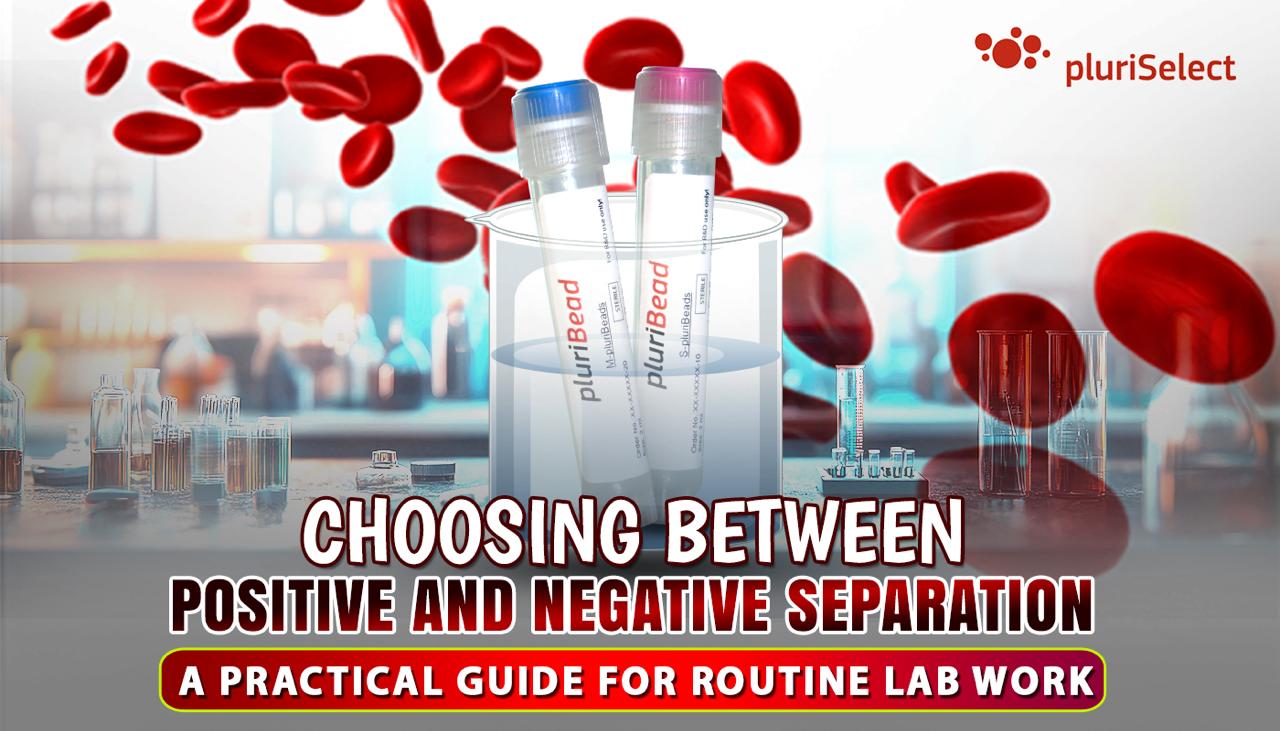
Choosing Between Positive and Negative Separation: A Practical Guide for Routine Lab Work tt
Cell separation is one of the most repeated steps in research and routine laboratory workflows. Whether you are working on immunology, diagnostics, bioprocessing, or sample preparation for downstream assays, the ability to isolate specific cell populations efficiently can influence the quality of your entire experiment.
Two of the most commonly used methods are positive cell separation and negative cell separation. Both techniques have clear benefits, and both have scenarios where one becomes more practical than the other. Researchers often debate which one to choose, especially when balancing purity, yield, cost, time, and cell integrity.
This guide breaks down positive and negative separation in a simple, practical way and helps you decide which approach best fits your routine lab work. To make the comparison easier, it also shows how tools like the pluriStrainer®, pluriBead®, and pluriSpin® systems support each workflow without complicating the process.
The right separation method saves time, reduces sample losses, and prevents unnecessary stress on cells. In many labs, cell separation becomes part of workflows such as:
Immunophenotyping
Cell culture
Functional assays
Sample cleanup before sorting
Single-cell studies
Cell enrichment for clinical research
Even small inefficiencies can affect reproducibility. For researchers working with primary cells, where every sample has value, choosing the right method becomes even more important.
Positive and negative separation take different routes to reach similar goals, but the practical experience of using each one is not the same. Understanding how each method works and when to prefer it will help you build smoother workflows.
Positive cell separation relies on labeling the target cells directly. Antibodies specific to the desired cell type bind to their surface, allowing the desired population to be held back while other cells flow through.
Direct Binding
A monoclonal antibody identifies and attaches to a specific structure on the target cell surface. This means the cells of interest are "touched" by the antibody.
Capture of Labeled Cells
Once the target cells bind to the antibody-coated beads or solid phase, they can be separated from the rest of the sample.
Flow-Through Contains Unwanted Cells
Cells that did not bind remain unbound and get removed in the enrichment steps.
The process is simple and is often chosen when purity is a priority.
Positive separation becomes much more practical when combined with tools designed to reduce sample prep and shorten enrichment steps. pluriBead® Technology supports this workflow by using non-magnetic, size-defined microparticles coated with monoclonal antibodies.
These beads bind to the target cells during incubation. Because the beads are larger than the cells, the bound complexes can easily be separated using a pluriStrainer®. This is a size-exclusion approach that avoids the need for magnets and reduces sample stress.
Uses non-magnetic monodisperse beads
Beads are coated with target-specific monoclonal antibodies
Works directly with whole blood, buffy coat, or other suspensions
No density centrifugation or erythrolysis required
Cells cannot phagocytize the beads due to their size
Separation is performed through a pluriStrainer®
Designed for research use only
This method is simple and speeds up routine workflows, especially when working with fresh blood samples.
Positive separation delivers several practical benefits:
Because the method binds directly to the target cells, the enrichment step is highly specific. This often results in greater purity in a shorter time compared to indirect approaches.
Positive separation usually requires fewer steps and less handling, which can lower overall costs.
With systems like pluriBead®, positive separation can be performed without preprocessing, allowing direct isolation from whole blood. This reduces instrument use and minimizes sample handling.
Unwanted cells, especially platelets or erythrocytes, are less likely to remain in the final product.
Because the target cells are coupled to beads or a solid phase, devices like cell strainer, pluriStrainers®, or magnets make capture straightforward.
The flow-through does not contain antibody-bound beads, making it suitable for an additional round of positive or negative enrichment if needed.
These advantages make positive separation ideal for workflows where purity, speed, and sample simplicity matter.
Negative cell separation takes a different approach. Instead of labeling the target cells, the method removes unwanted cells by binding them with antibodies. The desired cells remain untouched.
Label Only the Unwanted Cells
Antibodies bind to every cell type except the one you want to isolate.
Depletion of Labeled Cells
The labeled cells become the ones that are removed from the sample.
Target Cells Remain Free
The desired cells stay unbound, unstressed, and free of beads or antibodies.
Negative selection is often chosen when downstream assays require untouched cells.
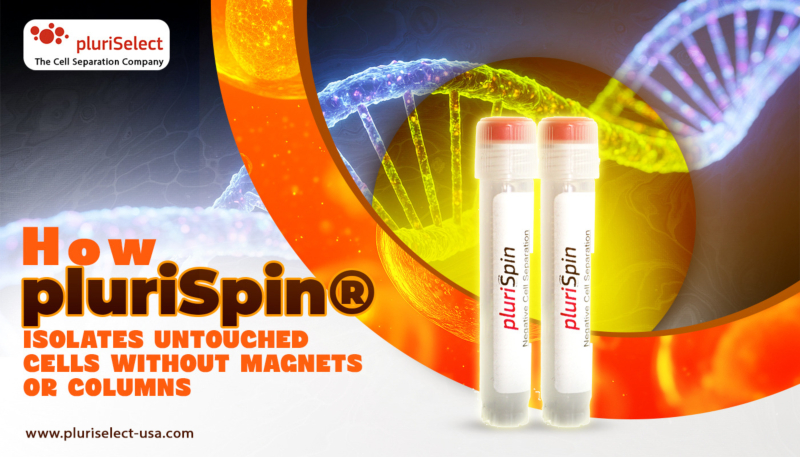
pluriSelect’s pluriSpin® system supports negative separation in a simple and effective way. It isolates viable, untouched, and purified cells in one step without magnets or columns.
This is helpful for researchers who want to avoid any risk of cell activation or blocking. Because the target cells are not tagged, they remain in their natural state.
Labels unwanted cells such as
T cells, B cells, NK cells, and granulocytes
Monocytes stay unlabeled and untouched
After incubation, the sample is centrifuged over a density medium
Unwanted cells settle with the red blood cells
Purified monocytes collect at the interface between plasma and the medium
The result is a clean, viable population suitable for culture, activation studies, or functional assays.
Negative separation offers many benefits, especially when cell integrity is important.
The most important advantage is that the target cells carry no beads or antibodies. This avoids unwanted activation or alteration of the cell surface.
pluriSpin® avoids the use of magnetic columns and their associated stress on cells.
Because the cells remain completely natural, they are suitable for:
Activation studies
Differentiation
Culture expansion
Functional assays
Negative separation often requires fewer technical steps after incubation.
Untouched cells respond better in downstream assays.
This method is ideal when cell behavior must remain unchanged.
Both methods are valuable in routine lab work. The best choice depends on your goal. Below is a practical breakdown.
Positive separation makes sense when:
Direct antibody binding produces precise enrichment, especially helpful in time-sensitive workflows.
Blood, buffy coat, and mixed suspensions benefit from positive identification of rare cells.
For many assays, being tagged with antibodies or beads does not affect performance.
pluriBead® allows direct isolation from whole blood.
Some cells, like granulocytes or certain lymphocyte subsets, tolerate labeling well.
Positive separation is widely used in immunology, oncology research, and preparation steps before flow cytometry.
Negative separation is the better choice when:
If your assay measures activation, signaling, or functional responses, untouched cells give more reliable results.
This is essential for receptor studies or sensitive cell types.
Culturing or stimulating cells works best when they have not been altered.
Untouched cells can be used for a wider range of applications after isolation.
pluriSpin® does not require magnetic columns or complex equipment.
Negative separation is commonly used for monocytes, stem cells, and fragile populations.
Both methods can be efficient, but their performance differs depending on the sample type and experimental needs.
Positive separation is usually faster because the binding is direct.
Negative separation may take longer due to extra depletion steps, especially when unwanted cells are abundant.
Positive separation with pluriBead® and pluriStrainer® minimizes handling, while negative separation may involve centrifugation or extra incubation.
Positive selection often results in higher purity, while negative selection prioritizes untouched cells.
Both systems from pluriSelect eliminate the need for complex equipment.
Positive separation uses the pluriStrainer® for simple sieving.
Negative separation uses the pluriSpin® density approach.
Positive selection touches the cell surface.
Negative selection leaves the cell surface natural and unaltered.
Understanding these differences helps researchers design their workflows more confidently.
Choosing between the two methods does not always require deep analysis. A few practical questions can guide your decision.
Functional testing?
Choose negative separation so the cells remain untouched.
Marker studies or phenotyping?
Positive separation works well.
Cell culture or stimulation studies?
Use negative separation to avoid receptor interference.
If the goal is to maximize the purity level in the shortest time, positive separation is ideal.
Both pluriBead® and pluriSpin® systems limit equipment needs, but positive separation with pluriStrainer® is especially simple—just incubation and sieving.
Positive separation using pluriBead® allows direct isolation without density centrifugation.
Choose negative separation if:
Activation must be prevented
Receptors must remain unbound
Cells need to remain untouched for culture or stimulation
Many labs choose systems that save time, reduce troubleshooting, and streamline daily work. The pluriSelect ecosystem supports both positive and negative separation in a practical, user-friendly way.
Simple size-based separation
No magnets
Works directly with whole blood
Produces high-purity results
Fast incubation and detachment
One-step negative isolation
No magnets or columns
Preserves cell integrity
Reliable results with minimal stress to cells
The combination of these tools gives researchers flexible options without needing new instruments or complicated protocols.
Here are common scenarios showing how each method is chosen in practice.
A team wants to study cytokine release after stimulating monocytes with different reagents. They cannot use any method that alters the cell surface beforehand.
Best choice: Negative separation using pluriSpin®
This provides untouched and viable monocytes for accurate activation studies.
A researcher needs a pure population to reduce background signals during phenotyping.
Best choice: Positive separation using pluriBead® + pluriStrainer®
The target cells are clearly enriched and easy to use in staining and acquisition.
Small blood volumes benefit from a quick, direct isolation method with minimal steps.
Best choice: Positive separation
Especially because pluriBead® does not require density centrifugation.
Long-term culture requires cells that have not been touched by antibodies or beads.
Best choice: Negative separation
Using pluriSpin® ensures natural cell behavior.
Choosing between positive and negative cell separation does not need to be complicated. Each method has clear strengths.
Purity is a priority
You want fast results
You need direct enrichment from whole blood
You prefer fewer workflow steps
You have robust cell types that tolerate labeling
Cells must remain untouched
Activation or receptor interference must be avoided
Functional assays follow separation
You want gentle handling
Purity is needed without altering the cells
Using tools like pluriBead®, pluriStrainer®, and pluriSpin® simplifies both approaches and supports flexible workflows for researchers and businesses.
Positive and negative cell separation are both essential techniques in routine laboratory work. The right choice depends on your experimental goals, the sensitivity of your downstream assays, and the importance of cell integrity.
Positive separation offers speed, high purity, and simple workflows, especially with practical tools like pluriBead® and pluriStrainer®. Negative separation, supported by pluriSpin®, preserves natural cell states and ensures researchers get untouched, reliable cells for functional studies. By understanding what each method offers and matching it to the needs of your samples, you can build more efficient, reproducible, and confident workflows in your lab.











 The Cell Separation Company