Cookie Settings
We use cookies to provide an optimal experience for you. Technically required cookies are used for making shopping possible, statistics are used for anonymized Google Analytics. You can read everything in our updated privacy policy.
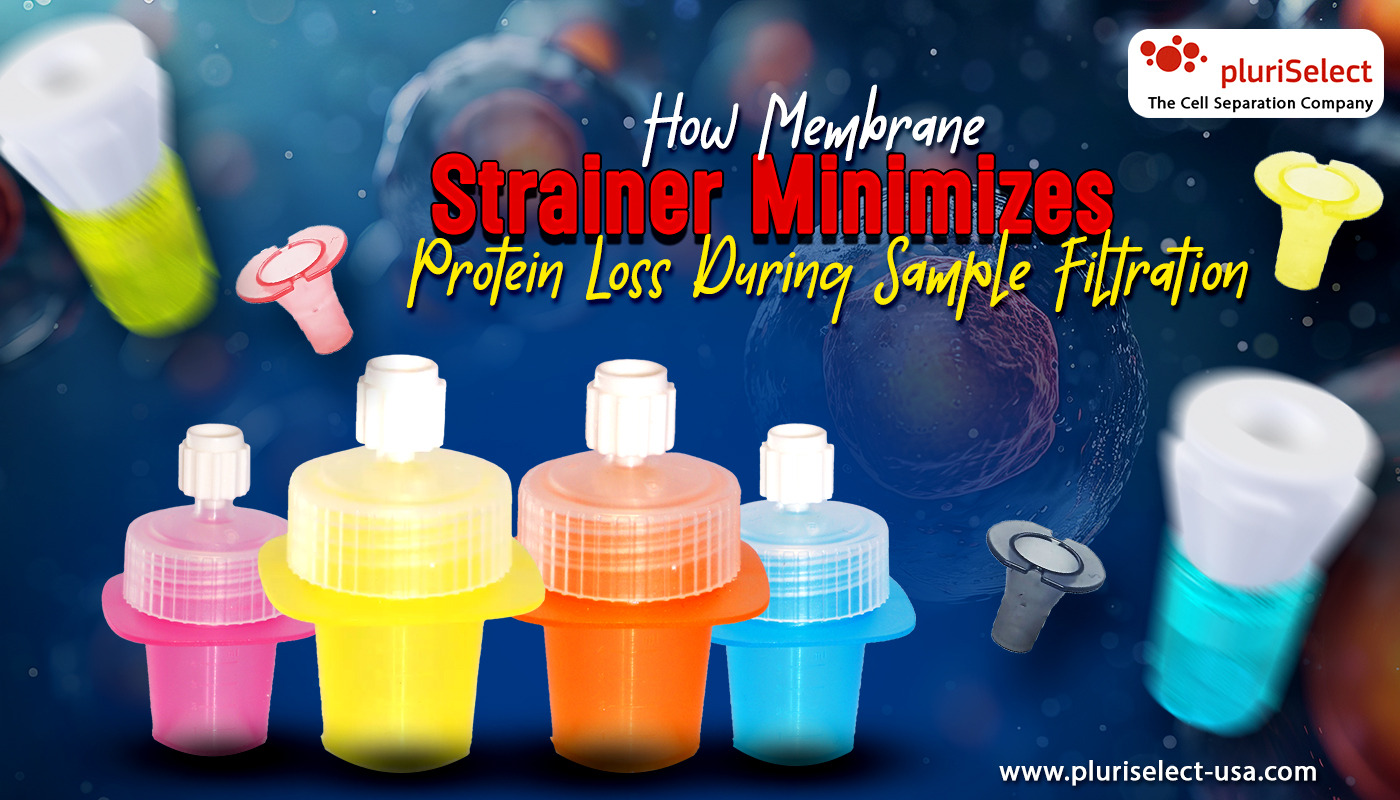
Filtration is a common step in laboratory sample preparation. Researchers use it to remove unwanted particles, separate material based on size, and prepare samples for further analysis. However, when working with protein-containing samples, filtration involves more than removing particles from a liquid. Researchers also need to consider how much of the protein remains available after the process.
Proteins are important components of many biological samples. They may be studied individually, measured as part of a mixture, or used in downstream experiments. Losing protein during sample preparation can affect the amount of material available for analysis and make it difficult to compare results across samples. One possible source of protein loss is the interaction between proteins and the filtration membrane. Proteins can associate with membrane surfaces through nonspecific interactions. When this happens, some of the protein may remain on the membrane instead of passing through with the liquid.
The membrane itself therefore becomes an important part of the sample preparation process. Its material, surface properties, and pore size can influence how filtration performs and how much sample remains available afterward. Membrane strainers provide a way to separate particles from liquid while considering these filtration requirements. The Membrane Strainer from pluriSelect® is available with defined pore sizes of 1, 3, 5, and 8 µm. Its membranes are non-hygroscopic and have low nonspecific protein binding, properties that support sample recovery during filtration.
These features are particularly relevant when researchers need to remove small particles while retaining proteins in the liquid fraction.
Understanding how membrane interactions contribute to protein loss can help researchers make better filtration decisions. Rather than treating filtration as a simple removal step, laboratories can consider the membrane, sample composition, and downstream requirements together. The objective is to select a filtration approach that removes unwanted material while helping preserve the protein-containing sample for further work.
Protein loss during filtration can occur for several reasons. One important factor is the interaction between proteins and the membrane surface.
When a protein-containing sample passes through a filtration device, proteins encounter the membrane material. Depending on the membrane properties and the characteristics of the protein, some proteins may interact with the surface instead of remaining in the liquid. This interaction is different from particle retention caused by pore size.
Membrane filtration separates material according to the relationship between the sample and the membrane.
Particles larger than the selected pore openings may be retained because they cannot pass through the membrane. This is the intended function of size-based filtration. Protein loss, however, can occur even when the protein is small enough to pass through the pores. A protein may interact with the membrane surface and remain associated with it. In this situation, the loss is related to membrane binding rather than the physical size of the protein.
This distinction is important because selecting a pore size alone does not address every possible source of protein loss. Researchers need to consider both the filtration objective and the interaction between the sample and the membrane.
Nonspecific protein binding occurs when proteins interact with a surface without a specific recognition mechanism. During filtration, these interactions can reduce the amount of protein recovered in the filtrate. The extent of protein binding depends on several factors, including the membrane material, surface properties, and characteristics of the sample.
Different proteins may interact differently with the same membrane. Similarly, different membrane materials may produce different levels of protein binding.
This means that a filtration device suitable for one protein-containing sample may not necessarily provide the same recovery when used with another. Researchers should therefore consider membrane properties when choosing a filtration method for protein-containing samples.
Membrane material influences how proteins interact with the filtration surface. Some materials may have greater nonspecific protein binding than others. When proteins associate with the membrane, they may not be recovered in the liquid fraction. This can be important when the sample contains proteins that need to remain available for further analysis. Selecting a membrane with low nonspecific protein binding can help address this concern.
The Membrane Strainer from pluriSelect® uses membrane properties designed to support sample recovery, including low nonspecific protein binding. This makes membrane selection relevant not only to particle removal but also to the amount of protein that remains available after filtration.
Membrane strainer design influences how a sample moves through the filtration device and how material interacts with the membrane. For protein-containing samples, two membrane properties are particularly relevant: pore size and nonspecific protein binding.
The Membrane Strainer is available with pore sizes of 1, 3, 5, and 8 µm. These defined pore sizes allow researchers to select a filtration level according to the particles they need to remove. A smaller pore size can retain smaller particles than a larger pore size, while a larger pore size allows more material to pass through. The choice depends on the sample composition and the filtration objective.
For example, researchers may need to remove small particles from a protein-containing liquid before conducting further analysis. Selecting an appropriate pore size can help remove the unwanted material while allowing the liquid fraction to pass through the membrane.
However, pore size should not be treated as the only factor affecting protein recovery. A membrane may have an appropriate pore size for particle removal but still interact with proteins through its surface properties. This is why membrane selection needs to consider both particle separation and protein binding.
One of the important properties of the Membrane Strainer is its low nonspecific protein binding. This property is relevant when researchers want to filter a sample without losing unnecessary amounts of protein through membrane interactions. During filtration, proteins may encounter the membrane surface as the liquid passes through.
A membrane with low nonspecific protein binding is designed to reduce these unwanted interactions. This supports the recovery of proteins in the liquid fraction after filtration.
For researchers preparing samples for protein analysis, this can be an important consideration because the purpose of filtration is often to remove unwanted particles rather than remove proteins from the sample.
Low nonspecific protein binding therefore addresses a different requirement from pore size. Pore size determines the particle separation level, while protein binding relates to interactions between proteins and the membrane. Considering both properties helps researchers select a membrane that better matches their sample preparation needs.
The Membrane Strainer also uses non-hygroscopic membranes. This property is relevant to sample recovery because the membrane is designed to avoid absorbing moisture.
When working with protein-containing samples, researchers need to consider how the filtration material interacts with the liquid and the material being processed. A non-hygroscopic membrane supports a filtration approach where sample recovery is an important consideration.
Combined with low nonspecific protein binding, this property makes the membrane suitable for workflows where researchers want to remove particles while maintaining the availability of proteins in the filtered sample. These membrane characteristics should be considered together rather than as separate product features.
A filtration device should be selected according to what researchers need to achieve.
For protein-containing samples, the objective may include:
Removing unwanted particles from a liquid.
Selecting a pore size appropriate for the particles being filtered.
Reducing nonspecific protein interactions with the membrane.
Supporting recovery of the protein-containing liquid.
Preparing the sample for further analysis or processing.
The Membrane Strainer combines defined pore sizes with non-hygroscopic membranes and low nonspecific protein binding.
These properties support a filtration approach that considers both particle removal and protein recovery. The important point is that membrane design should be evaluated according to the needs of the sample rather than only the size of the particles being removed.
Selecting a suitable membrane is an important part of filtration, but researchers also need to consider how the filtration workflow is organized. The sample composition, pore size, filtration conditions, and downstream requirements all contribute to the final result.
The first step is to identify the particles that need to be separated from the sample. Researchers should consider the size of the unwanted material and select a pore size appropriate for the filtration objective.
The Membrane Strainer offers four pore sizes: 1, 3, 5, and 8 µm. A suitable pore size should allow the unwanted particles to be retained while supporting the passage of the desired liquid fraction. Selecting a pore size that is smaller than necessary may not provide an advantage if the target particles can already be removed with a larger opening. Similarly, a pore size that is too large may allow unwanted particles to pass through. The selection should therefore be based on the sample and the intended separation.
Researchers should also determine which fraction contains the material they want to retain. In many protein filtration workflows, the protein-containing liquid is the desired fraction.
The filtration setup should therefore be planned around removing unwanted particles while preserving the liquid for further analysis. This requires attention to both the membrane pore size and the membrane's interaction with proteins. A membrane with low nonspecific protein binding can help reduce protein association with the filtration surface. However, the actual recovery should still be evaluated for the specific sample and filtration conditions.
Sample handling is another important consideration. When a sample is transferred between several containers or processed through multiple unnecessary steps, additional opportunities for material loss can arise.
For protein-containing samples, researchers should consider whether the workflow can be organized to reduce unnecessary transfers. This does not mean that every filtration process needs to use the fewest possible steps.
Instead, the workflow should include the steps required for the intended separation while avoiding handling that does not contribute to the final result. A clear filtration plan can help researchers maintain consistency across samples.
Sample volume can influence how filtration is organized. Researchers should consider the amount of sample, the particle content, and the membrane area available in the selected device.
If a sample contains a large amount of unwanted material, the filtration process may need to be adjusted according to the characteristics of the sample. The purpose is to avoid treating every protein-containing sample as if it had the same filtration requirements. A suitable setup should reflect the sample volume and the amount of material that needs to be removed.
Protein recovery should be assessed according to the requirements of the experiment. Researchers may compare the protein amount before and after filtration to determine how much material remains available in the liquid fraction.
This can help identify whether the filtration process is meeting the intended recovery objective. The evaluation should also consider the sample composition and the method used to measure protein. A difference in measured protein concentration does not automatically identify the cause of loss. Researchers should consider membrane binding, sample handling, and other workflow factors when interpreting the results.
Evaluating recovery provides a practical way to determine whether the selected membrane and filtration conditions are appropriate for the specific sample.
Consistency is important when processing several samples or comparing results across experiments. Researchers should use an established procedure for membrane selection, sample handling, and filtration.
The appropriate conditions depend on the sample and the filtration device. Rather than assuming that one set of conditions works for every protein-containing sample, researchers should evaluate the setup according to their intended application. This approach helps make filtration results easier to interpret and compare.
Protein recovery is an important consideration when filtration is used to prepare samples for further analysis. Although filtration is often intended to remove unwanted particles, proteins can also interact with the membrane surface. Nonspecific protein binding may reduce the amount of protein recovered in the liquid fraction, making membrane selection an important part of sample preparation. The Membrane Strainer from pluriSelect® supports protein-containing sample filtration through several relevant membrane properties.
Its defined pore sizes of 1, 3, 5, and 8 µm provide options for particle removal according to the sample. Its non-hygroscopic membranes and low nonspecific protein binding are also relevant when researchers need to preserve the protein-containing fraction during filtration. These properties address different parts of the workflow.
Pore size determines which particles can pass through the membrane, while membrane surface properties influence how proteins interact with the filtration material. Researchers should therefore consider both when selecting a filtration device.
The filtration process should also be planned around the intended downstream use. Identifying the target fraction, choosing an appropriate pore size, reducing unnecessary sample transfers, and evaluating protein recovery can help create a more suitable workflow. No single membrane or filtration condition will automatically provide the same recovery for every sample. Protein characteristics, sample composition, and filtration requirements all need to be considered.
For laboratories working with protein-containing samples, the most useful approach is to select a membrane based on the complete filtration objective rather than particle size alone. By combining suitable pore sizes with membrane properties designed to support sample recovery, the Membrane Strainer provides a practical option for filtration workflows where minimizing protein loss is an important consideration.











 The Cell Separation Company