Cookie Settings
We use cookies to provide an optimal experience for you. Technically required cookies are used for making shopping possible, statistics are used for anonymized Google Analytics. You can read everything in our updated privacy policy.
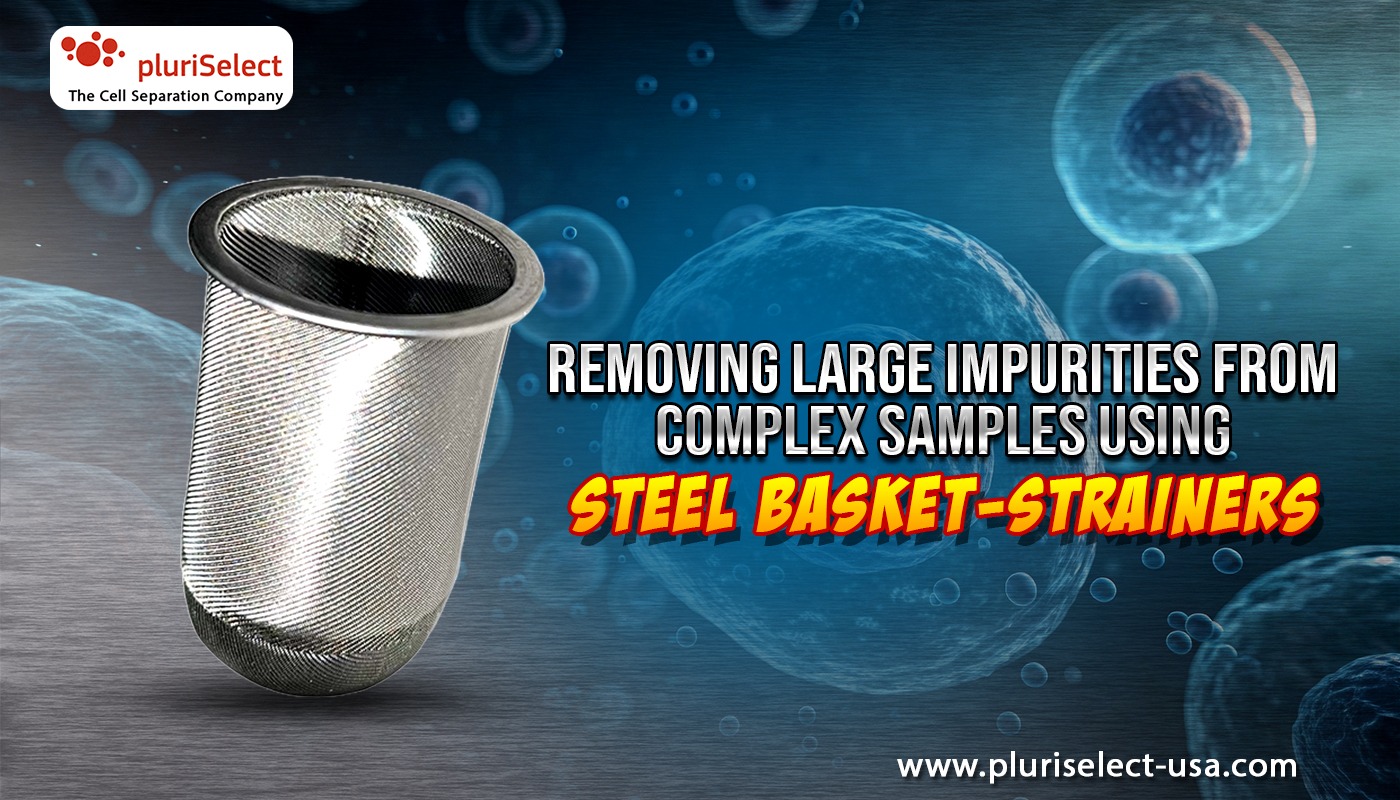
Removing large impurities from complex samples is one of the most overlooked but critical steps in laboratory preparation. Whether working with soil suspensions, plant extracts, sediment samples, industrial residues, or mixed biological materials, large debris can interfere with downstream analysis, clog fine filters, and compromise overall workflow efficiency. Before advanced processing begins, unwanted solid fragments must be separated in a controlled and reliable way.
Many laboratories rely on membrane-based tools such as a Lab cell strainer for particle filtration. These tools work well for suspended cells and fine debris. However, when samples contain dense, solid-heavy material, traditional mesh strainers such as a Cell strainer 40 um, Cell strainer 70 um, or cell strainer 100 um are not always the best starting point. In such cases, a Lab steel strainer, specifically a Steel Basket-Strainer, offers a more durable and effective solution for removing large impurities before fine filtration begins.
This article explores how Steel Basket-Strainers support complex sample preparation, when they outperform standard filtration devices, and how they integrate into broader workflows involving cell separation technology and cell enrichment techniques.
Complex samples differ from simple liquid suspensions. Instead of particles floating freely in solution, many laboratory samples contain:
Soil fragments
Organic plant fibers
Sediment particles
Mineral residues
Industrial by-products
Coagulated or clumped material
These samples are often dense, irregular, and mechanically challenging. Attempting to filter them directly through a fine Cell Strainer can lead to immediate clogging, membrane deformation, or incomplete flow-through. A 40 um cell strainer or 70 um cell strainer is optimized for refined cell suspensions—not for extracting liquid from porous solids or removing large, heavy debris.
This is where the Steel Basket-Strainer becomes valuable. Instead of forcing dense material through a delicate mesh, it supports gravity-based separation while retaining solid impurities inside a stable, reusable metal structure.
Standard mesh-based strainers such as a Cell strainer 40 um, Cell strainer 70 um, or 100 um strainer are ideal when:
Preparing single-cell suspensions
Removing small aggregates
Clarifying blood or tissue digests
Supporting downstream cell enrichment techniques
However, they are not designed to:
Handle heavy solid loads
Withstand high mechanical stress
Extract liquid from porous materials
Process large masses of sediment or plant matter
When overloaded with dense material, these devices clog quickly. Flow slows dramatically. Researchers may attempt to compensate by applying pressure or agitation, which can damage the mesh and reduce filtration accuracy.
In workflows involving multi-stage separation, starting with a fine mesh is inefficient. Large impurities should be removed first using a mechanically stable tool—this protects finer devices and improves overall efficiency.
The Steel Basket-Strainer is a gravity-based separation device designed for solid-heavy samples. Unlike plastic mesh strainers, it is constructed from non-magnetic SS 316 stainless steel, offering exceptional durability and chemical resistance.
Key structural advantages include:
Fits inside a standard 50 mL centrifuge tube
Measures 45 mm in length
Retains up to 20 mL volume
Handles up to 30 g of solid material at 2,000 × g
Fully reusable
Compatible with heat sterilization and autoclaving
Rather than acting as a fine membrane, the Steel Basket-Strainer functions as a supportive extraction chamber. Porous or dense solids are placed inside the basket, and gravity allows liquid to drain downward into the tube below.
This design is fundamentally different from a traditional Lab cell strainer, yet it complements them perfectly in staged workflows.
Many advanced workflows involve multiple levels of filtration. For instance:
Remove coarse debris
Clarify medium-sized particles
Apply fine filtration (40 µm, 70 µm, 100 µm)
Proceed to enrichment or analysis
Starting with a Cell strainer 100 um when large solids are present often leads to immediate blockage. Instead, using a Steel Basket-Strainer first creates a cleaner starting suspension.
After coarse impurities are removed:
A 100 um strainer can refine remaining aggregates
A 70 um cell strainer can prepare uniform suspensions
A 40 um cell strainer can support sensitive cell separation technology
This layered approach improves efficiency and reduces consumable waste.
Environmental samples such as soil, sediment, and water deposits frequently contain dense impurities. The Steel Basket-Strainer allows extraction of liquids without forcing material through fragile membranes.
Plant-based extracts and soil samples benefit from gravity-based separation. Large fibers and debris are retained, leaving cleaner extract for further filtration.
Industrial by-products and deposits often contain solid-heavy matrices. A Lab steel strainer provides mechanical strength where plastic devices would fail.
Although not a replacement for fine mesh devices used in cell separation technology, Steel Basket-Strainers are useful during early preparation stages when removing visible clumps or solid fragments.
The SS 316 stainless steel construction offers several advantages:
Resistance to corrosion
Compatibility with solvents
Structural integrity under centrifugation
Reusability over multiple cycles
Unlike disposable mesh products such as a Cell strainer 40 um, the Steel Basket-Strainer can be sterilized and reused. This makes it cost-effective for laboratories handling large volumes of solid-heavy material.
Mechanical strength is particularly important when:
Processing up to 30 g of solids
Centrifuging at 2,000 × g
Extracting solvents from porous materials
Removing heavy mineral fragments
Plastic strainers simply are not designed for this load capacity.
While the Steel Basket-Strainer itself is not a fine particle separator, it supports cell separation technology by preparing cleaner starting material.
In workflows involving:
Blood-derived materials
Tissue digests
Mixed biological suspensions
Large impurities must be removed before applying a Cell Strainer with precise mesh sizes. By pre-clearing debris, the Steel Basket-Strainer ensures that downstream Cell enrichment techniques function more efficiently.
Cleaner input equals:
Better flow rates
Reduced clogging
Higher cell recovery
Improved reproducibility
A typical multi-step workflow may look like this:
Extract liquid from porous sample using Steel Basket-Strainer
Clarify with a cell strainer 100 um
Refine with a 70 um cell strainer
Final polish using a 40 um cell strainer
Proceed to cell separation technology or enrichment
Each stage removes progressively smaller impurities. Without the first step, finer mesh devices are forced to perform tasks beyond their intended capacity. This approach maximizes the performance of each tool in the sequence.
Choose a Steel Basket-Strainer when:
Samples contain visible solid debris
Porous materials trap liquids
Fine membranes clog immediately
Mechanical strength is required
Reusability is preferred
Choose a Cell strainer 70 um or 40 um cell strainer when:
Working with refined suspensions
Preparing single-cell solutions
Supporting cell enrichment techniques
Final clarification is needed
The two tools are not competitors—they serve complementary roles.
Removing large impurities from complex samples is not simply a matter of filtration—it requires the right mechanical support and separation strategy. Steel Basket-Strainers provide a stable, gravity-based solution for handling porous and solid-heavy materials without clogging or structural failure.
By integrating a Lab steel strainer at the beginning of the workflow, laboratories protect fine mesh devices such as a Cell strainer 40 um, Cell strainer 70 um, and cell strainer 100 um, ensuring they operate within their optimal range. This staged approach improves efficiency, reduces downtime, and supports reliable downstream processing.
Whether used in environmental testing, agricultural research, industrial analysis, or biological preparation, Steel Basket-Strainers offer strength, durability, and controlled impurity removal. For laboratories seeking a dependable method to manage complex samples before fine filtration or cell separation technology steps, the Steel Basket-Strainer stands as a practical and essential tool.













 The Cell Separation Company